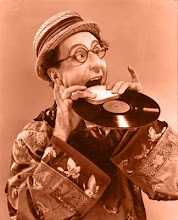
"Wanna buy a duck?"
The studio audience convulses in laughter as do millions of listeners. Who
is this strange man and
why does he want to sell us a
duck?? It's so improbable! So
absurd! Penner soaked up the laughter like a sponge. Only a few years before, he had been a struggling burlesque comic. Today, he was one of the nation's highest-rated radio comedians, earning $7000 a week, his catchphrases and silly laugh a national craze. Never before had the nation so totally embraced a performer in so short a time.
By 1935, Joe Penner was effectively washed up in radio comedy. By 1941, he was dead.
Penner was the real success story of American radio's coming-of-age. Eddie Cantor, Ed Wynn, and Jack Pearl had all been successful on the stage for years before entering radio. Wynn and Cantor were practically American institutions before ever having stepped before a microphone. Even Jack Pearl had been a Zeigfeld headliner. In 1931, Joe Penner was little more than a moderately successful burlesque and vaudeville comic. The future looked dim for Joe; vaudeville was dying fast and burlesque had seen better days. And then a miracle happened; Penner switched out one word in one of his catchphrases. Instead of asking his straightman "Wanna buy a hippopotamamanous?" or "Wanna buy an ash barrel?" as per usual, he asked "Wanna buy a
duck?". And the crowd went berserk! Maybe it was the funny way Penner said "duck", like a punch-drunk yokel. Maybe audiences in 1931 understood something we don't today about the innate humor of waterfowl. Whatever it was, in 1933, it propelled Joe Penner out of the small-time and onto the top-rated
Rudy Vallee Hour where he became a literal overnight sensation. He was given his own series,
The Baker's Broadcast, sponsored by Fleischmann's Yeast, and by early 1934 it was the fourth most popular show on the air, pulling in better ratings than
Amos N' Andy. Joe Penner was voted Radio's Outstanding Comedian by
Radio Stars magazine. Toys and games were manufactured featuring his likeness.
But the decay began to set in early. For some reason, it never seemed to dawn on anyone that Penner was, well.. average. Not that he wasn't ever funny, mind you, but he wasn't especially good, either. He certainly wasn't on a par with Wynn and Cantor and Pearl and
Amos N' Andy. Penner had slipped under the radar. In these early and insecure days of radio when a comic's unique vocal gimmick or catchphrase acted as a valuable identifying hook for audiences at home, Joe was a comic whose act consisted
almost entirely of hooks! By 1934, it must have been apparent to everyone but the sponsor that Penner was running his existing catchphrases into the ground. The solution?
More catchphrases!
Better catchphrases!
"Don't be silly! Don't be silly!"
"Don't ever
dooo-oo-oo-o that!"
"Oh, you
nah-hah-sty man!"
"To be sure, to be sure!"
"Oh, wo-
ho-ho is me!"
Penner grew increasingly neurotic. He knew he had to start introducing variety into his act but the sponsor didn't agree. The catchphrases, or "gag lines" as they were called, were a national craze. Why tinker with success? And even then there was another more fundamental problem; was he talented enough to transcend vaudeville style clowning? Penner must have had his doubts. He suddenly quit
The Baker's Broadcast in June, 1935, and went AWOL from media for more than a full year, perhaps for fear of killing his career through overexposure but just as likely because of his fragile nerves. Recognizing Jack Benny's successful new blend of character comedy, gags, and situational humor as the new trend in radio comedy, Penner hired away Benny's head writer Harry Conn with the hope that Conn could help him re-establish his style. The new
Joe Penner Show debuted on October 4th, 1936 on the CBS network and featured Penner in a sitcom format as the black sheep of the "Park Avenue Penners". But Penner had been away from the airwaves for too long and the novelty-hungry public had moved on. More ominously, the new format proved that Penner was purely one-dimensional and incapable of handling engaging character comedy. The ratings for his new show began slipping almost immediately. It folded in 1938.
By that time Penner was in Hollywood, appearing in lackluster B-comedies for RKO (already having been used and tossed aside by Paramount after a brief string of college musicals). While they had their moments, such films as
I'm From the City (1938) were pure bottom-of-the-bill filler. By 1940, Joe Penner was in the unenviable position of being a celebrity has-been at the age of 35. Two new radio series had failed miserably. Any hopes that he might be able to revive his career were dashed when, on January 10th, 1941, he died of a heart attack in his sleep.

And now that you're all in the mood for high hilarity, I'm gonna break new ground here and make available the complete contents of the rare
Joe Penner Joy Book! Don't never say I ain't never did nothin' fer ya! So popular was Joe in 1934 that Dell devoted this 35 page souvenir magazine to him. Inside, you'll learn as much about Joe Penner as his press agent wanted you to know. Read all about his childhood, his struggles in vaudeville, his phenomenal rise to superstardom, and find out exactly how he comes up with all those zany gag-lines! Plus: songs, gag, cartoons, and more,
more, MORE! Click here to go to the file-sharing service where I've stored the 11.9 MB folder containing the contents.
NOTE: right-click on "Your Download is Ready. Click Here to Download" and choose "save as". If you click on the link directly, the file will take more than a
day to download! Follow the instructions and it'll take less than a couple of minutes with DSL. Enjoy!

 Joe Penner's post-Baker's Broadcast radio career was one long downhill slide. This blurb from the October 1st, 1938 issue of Radio Guide strives to draw a distinction between the old "wanna buy a duck?" Penner and the new "situation comedy" Penner, whose second series for CBS was to premiere on the 5th. Of course, the "wanna buy a duck?" phase of Penner's career had been over since 1936 when he
 ditched Baker's and pilfered Jack Benny's head writer Harry Conn (overrated, as it turned out) for a new series structured around the misadventures of the "Park Avenue Penners". Apparently few noticed. Joe's monogrammed shirt is pretty cool, though.