Friday, October 31, 2008

The Terror-ific Third Annual Third Banana Halloween Anniversary Spooktacular Clip-O-Thon... The Third!

Excerpts from The Paul Lynde Halloween Special! I just think it's amazing that this even exists! KISS! Margaret Hamilton! Tim Conway! Billy Barty! KISS! Betty White! Donny and Marie Osmond! Billie Hayes!! KISS!! Truly one of the last gasps of old-style capital "S" Showbiz.


A rare Bela Lugosi appearance on an even rarer TV show, the 1949 video version of the radio classic Suspense. And check out the 35 year old Ray Walston!


The Adventures of Ozzie and Harriet: Halloween Party


Excerpts from Capulina Contra Los Monstruos (1974)


Clavillazo in El Castillo De Los Monstruos (1957)


Eegah! (1962) "Watch out for snakes!"


Popeye in Fright To the Finish (1954). You know, if standard drug store vanishing cream really did make people invisible, I think everyone would be much more cavalier about invisible people..


And take a tip from the fine folks at Centron, kids, and have a safe and paranoid Halloween! Remember homemade Halloween treats? Remember fruit? Too bad there were all those all those poisonings and hidden razor blades and.. what? That didn't happen?


And here's Centron's 1985 edition of Halloween Safety. Ramp up the dread! Pour on the paranoia!! Die, Halloween, die!!! Christ.. by 1985, we even had to worry about carving the damn pumpkin!! "Getting my insides scooped out tickles me!"


Labels: , , , , , , , , ,

Wednesday, October 31, 2007

The Terror-ific Second Annual Third Banana Halloween Anniversary Spooktacular Clip-O-Thon!

Two years, 212 posts and counting, folks, and we ain't dead yet! Here are a few ghost-tastic ghoul-clips for your vampire-joyment. Boo!

Bela Lugosi performs the "Vampire Bat Illusion" with Shirley Patterson in this 1953 episode of You Asked For It. At the end, Bela references a couple of never-to-be projects: The Phantom Ghoul (in 3-D!) and a TV series, Dr. Acula ("Dracula?" asks host Art Baker. "Dracula??" replies Bela, shocked. "For heaven's sake no! Just.. Dr. Acula!").


Germán Valdés 'Tin-Tan' and his brother Manuel 'Loco' Valdés perform a spirited (ho ho!) number entitled "Un Sueño Es Solo Un Sueño" in Los Fantasmas burlones (1965). Antonio Espino 'Clavillazo' and Adalberto Martínez 'Resortes' watch from the audience. Mexicomics and in-camera effects galore! God, I love this film!


Sid Noel's Morgus the Magnificent was, in my opinion, the cleverest of the 50s-60s TV horror hosts (perhaps I should say is as Dr. Morgus is reportedly still in the game). As much as I like Ghoulardi and Zacherly, Dr. Momus Alexander Morgus tops them all thanks to Noel's wonderfully dry delivery, clever physical comedy, and his insistence on backing his character up with a performance philosophy. Based out of New Orleans, Dr. Morgus was the first horror host to star in his own regional feature, The Wacky World of Doctor Morgus, in 1962. In all, it's not a particularly good movie, but whenever the silly plot is shoved out of the way long enough for one of Dr. Morgus's lab-based set-pieces, it shines. Some of the best early-60s "sick" humor I've seen.


Atlanta TV horror host Bestoink Dooley (George Ellis) also starred in his own regional film, The Legend of Blood Mountain, in 1965. It's a jaw-dropper. Some of the boldest, most in-your-face padding in the history of film, bargain monster, awkward comedy sequences, and Groucho's girlfriend/secretary/live-in tormentor Erin Fleming in her first motion picture! It's much less a comedy than The Wacky World of Doctor Morgus, and not just because most of the comedy falls flat. They went for more scares than laughs and, unfortunately, failed to deliver either.


Here's a little stretch of padding I like to call... Bestoink Dooley Goes to Sleep!


Nighty-night! IF YOU DARE!!

Labels: , , , , , , , ,

Friday, May 11, 2007

¡Nunca me hagan eso!

When gringos talk about classic Mexican comedy, which admittedly is scarcely this side of never, nine times out of ten what they're really talking about is Mario Moreno, "Cantinflas". Not surprising as Moreno was the only one of dozens of popular Mexican comics of the 40s and 50s to break into Hollywood. Just about everyone has seen the Michael Todd version of Around the World in 80 Days at least once. But while Moreno's reputation is justly deserved, it has to be admitted that he's usually something of a mystery to non-Spanish speakers. While an extremely talented mime, most of Moreno's unparalleled popularity in Mexico and South America was due to his comically confused manner of speaking, "Cantinfleada", which is completely absent from his two Hollywood features. Coupled with the fact that Moreno's screen character was based largely on regional archetypes, it's little wonder that Cantinflas remains an enigma in the US, a kind of shorthand for "Mexican comedian".

But while Cantinflas was the unquestioned king of Mexican comedy in the 40s and 50s, the lower ranks were occupied by comedians like Germán Valdez (Tin-Tan) and Adalberto Martinez (Resortes), talented comics of far less pretension than Mario Moreno.

Then there's Antonio Espino, "Clavillazo" (roughly translated as "Pinhead"). It's an understatement to say that there's nothing pretentious or mysterious about Clavillazo. In his oversized suit and peculiar (and ubiquitous) hat, Antonio Espino walks a line between comic and clown, eager and willing to go the extra mile to get a laugh, yet at all times in admirable control of his performances. In El Castillo de los monstruos (1958), for instance, he emphasizes his grief in one scene by smashing crockery over his head, a ridiculously outsized gesture, but meticulously timed as a way to punctuate the sequence. His doubletakes are pure cartoon, often including going stiff with shock and falling backwards out of frame. For Espino, pulling funny faces and making wild getures aren't simply quick ways to get laughs; they amount to a definite performance style, comic excess as aesthetic. Clavillazo was frequently billed as "El Hombre de las Manos Elocuentes" due to his reliance on exaggerated hand gestures to punctuate dialogue. Even the simplest lines are cause for Clavillazo to throw his body into extreme poses. He's also a master of catchphrases, using a good half dozen repeatedly including "la cosa está calmada", "¡nunca me hagan eso!", and "No más!".

The most remarkable thing about Antonio Espino, though, is that although subtlety is largely absent from his performances, he's still likable, sympathetic, and at times even charming. Like Buster Keaton before him, Clavillazo is usually portrayed as an underdog who wins the girl and saves the day through sudden bursts of previously untapped courage and guile.. and often, in Clavillazo's case, sheer unmitigated gall. Thanks to Antonio Espino's evident self-awareness as a performer, his character is always something more than a pile of comedy gimmicks.

From 1951 to 1965, Antonio Espino starred in thirty-two features for virtually every studio in Mexico. He tackled every comic genre at least once including westerns, mysteries, fantasies, horror and science fiction spoofs, and situation comedies. Espino appears to have hit his peak in 1956 and 1957 when, aside from hosting a hit TV series, he produced a remarkable ten movies in two years including the horror spoofs El Fantasma de la casa roja and El Castillo de los monstruos (in which Clavillazo battles a mad scientist, a vampire, Frankenstein's monster, two wolf men, and the Creature from the Black Lagoon). In 1965, the Mexican film industry tanking, Sotomayor teamed Clavillazo with comedians Tin-Tan, Resortes, and "Loco" Valdez in Los Fantasmas burlones, a low-budget grab-bag featuring ultra-cheap ghost effects, old footage from the stars' previous films, and some of the least culturally sensitive musical numbers ever committed to film. And then, despite not the slightest hint of decline in Espino's comic gusto, he practically vanished from the screen, making only rare, fleeting appearances until his retirement in 1984. For years, Espino gave his performances everything he had and then some. Perhaps he simply wore himself out. Antonio Espino died of a heart attack in Mexico City in 1993 at the age of 83. He deserves to be better known.

I've seen eleven of Clavillazo's features and only one, The Phantom of the Red House (1956), has ever been dubbed into English (as a part of K. Gordon Murray's World of Terror package). None that I know of have ever been subtitled, something that's only slightly less true of Cantinflas's much better-known output. Of the lot, El Castillo de los monstruos is, in my opinion, the best showcase of Espino's abilities as a comic. I've included three scenes from it along with a fourth from Espino's very impressive 1958 Eastmancolor fantasy Aladino y la lámpara maravillosa. Either would have been hits on American TV or as kiddie matinee features back in the early 60s had they been dubbed. I have to assume that K. Gordon Murray couldn't secure American distribution rights to these because they're right up his alley.


In El Castillo de los monstruos excerpt #1, town undertaker Clavillazo has allowed Evangelina Elizondo the use of his humble apartment and must find lodging in the local boarding house. Unfortunately, the son of the boarding house's owner is a dangerous madman. ¡Loco!


In excerpt #2, Clavillazo serenades Elizondo with the help of a transistor radio. Even without subtitles, this is a nice scene.


Excerpt #3: In this sequence, Clavillazo finally comes face-to-mask with the monsters which include the great German Robles, star of El Vampiro (1957) and
El Ataúd del Vampiro (1958), as Count Lavud, the Mexican equivalent of getting Lugosi to reprise his role as Dracula in Abbott and Costello Meet Frankenstein. Poor Evangelina has been hypnotized by the mad doctor into believing she's "Galatea".


This excerpt from
Aladino y la lámpara maravillosa is pretty much self-explanatory.

Labels: , , , , ,

Monday, October 31, 2005

Obscure Vintage Comedies Ate My Brain: The Halloween Edition

Mummy's Boys (1936): Bill Sherman covered this one pretty thoroughly last week, but I'm going to add my two cents just the same. Bob Woolsey smoothtalks himself and his pal Bert Wheeler into a Egyptian expedition that hopes to return "cursed treasure" that has been blamed for a series of mysterious deaths (a la Lord Carnarvon). Is the cause truly supernatural? Nope. After being chased endlessly around an Egyptian tomb by a phoney mummy with a syringe full of poison (it's a fairly nasty idea when you think about it, but it's played for laughs just the same), Bert and Bob reveal the real killer to be the guy you suspected since frame one. This is far from Wheeler and Woolsey's best, but it's not the disaster it has been painted by biographer Edward Watz. Woolsey's aggressively "ugly American" behavior in Egypt is so broad that it comes across as a self-parody, and the running gag about Bert's need to take quick naps (anywhere, anytime) to clear up his faulty memory is worth a few genuine laughs. And, like almost all RKO Wheeler and Woolsey pictures, Mummy's Boys looks very good. Most importantly, it's the first of a genre. Although short "scare" comedies had long been popular (with the ghosts and ghouls invariably revealed to be ordinary mortals up to no good), this is the first example of the wisecracking comics v. monster(s) feature format that would reach its apex with Abbott and Costello Meet Frankenstein in 1948 (and which would be a staple of Mexican filmmaking through the early 1970s).


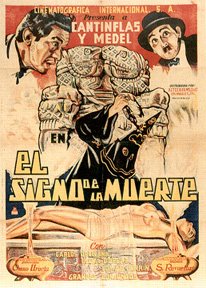
El Signo de la muerte (1939): The mother of all Mexican horror spoofs, a genre the Mexican film industry went further with than anyone else ever dared. A wizard with a line in Aztec sorcery must sacrifice four virgins in order to raise the spirit of Quetzalcoatl. By day, he's an anthropologist and his assistant is a very young Cantinflas, so new to films that he doesn't even have his famous costume together yet. This rather lavish-looking Mexican horror comedy also features topless women and some genuine gore.. in 1939! Clearly there way no Mexican equivalent of the Hays Office to contend with. Cantinflas actually shares top billing with comedian Medel who looks and acts as if he just stepped out of a 1916 Keystone comedy. Some sequences in El Signo de la muerte are worthy of a "straight" horror film, something that can't be said for most, if not all, other classic Mexican horror-spoofs.


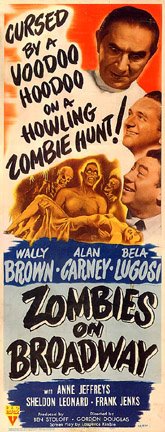
Zombies On Broadway (1945): Brown and Carney, the Un-comedy team, are publicity agents for gangster Sheldon Leonard (who else?) who threatens to t'row dem t'roo da door an out da winda unless they come up with the live zombie they promised for the grand opening of his new theme-club, The Zombie Hut. Zombies are really popular! So Brown and Carney are forced at gunpoint to go to the Caribbean island of San Sebastian to find one. A knife-throwing dancer, Anne Jeffreys, promises to lead the uncomics to some zombies in return for their help getting her off the island, but they all end up getting abducted after B&C disrupt a Zombie Ceremony (with hilarious consequences). They find themselves prisoners in the jungle castle of Bela Lugosi, a mad scientist who has developed a short-term zombie-making serum. Bela makes eyes at Anne and makes the hapless comics dig their own graves.. but they're so dumb, they don't even realize it!! (ha ha he ho!). In one genuinely creepy scene, B&C do their take on Abbott and Costello's the-comic-sees-the-ghost-but-the-straightman-doesn't-believe-him shtick. After much dialogue to the effect of "JERRY!! I SAW IT!!!" and "Aw, yer nuts.", Carney is stealthily abducted out of his bed by Zombie Darby Jones, zombified by Bela, and placed back in the bed, now with CREEPY, BULGY ZOMBIE EYES! When the Zombie comes back for Brown (whose back was turned when Carney was abducted), he's carried from the room screaming "MIKE!! I BELIEVE YOU NOW!! MIKE!!!" That would be unnerving enough, but then the camera cuts back to Zombie Carney in bed, staring at nothing with his big, fake eyeballs, and he suddenly cracks this weird little half-smile. It's creepy. I'm not kidding. Long story short, Bela gets brained with a shovel by his pet Zombie before he gets a chance to zombify Anne Jeffreys, and Jeffreys and Brown head back to the US with Zombie Carney in tow as the promised live zombie for Leonard's silly club. But the serum wears off before Leonard gets to see his new zombie! A fight breaks out and Leonard somehow ends up getting injected with Zombie Juice. He's his own featured attraction! It's a hoot! And then Brown ends up sitting on the syringe full of zombie serum and HE becomes a bulgy-eyed zombie! Big laff finish! Intentional or not, this is one of the only classic horror comedies that has anything in it resembling genuine scares. And it had better, because, unlike most classic horror comedies, it has nothing in it resembling genuine comedy. Like RKO's previous, legit zombie picture, Jacques Tourneur's I Walked With A Zombie (1943), ZOB is very atmospheric and the cinematography is terrific. If Brown and Carney were an actual comedy team rather than an amazingly lifelike simulation of one, Zombies On Broadway would be a classic counterpoint to Tourneur's film. It isn't, by any stretch of the imagination, but it's no time-waster, either.


Bela Lugosi Meets a Brooklyn Gorilla (1952): I love Mitchell and Petrillo and I don't care if the whole world knows it. Sammy Petrillo does a more than credible Jerry Lewis impression and while Duke Mitchell may be no substitute for Dean Martin, he's not really trying to be. And I personally don't think his singing is so bad (he got much better; see his 1978 magnum opus The Executioner). Sammy and Duke accidentally parachute onto a tropical island where they meet some "natives" and where Bela Lugosi's mad scientist has set up his lab in yet another jungle castle. Lugosi's scheme this time around is to create a formula that will reverse the evolutionary process and/or turn things into gorillas. Meanwhile, Duke falls for native girl Nona (Charlita) while Sammy is fallen for by Charlita's sister Saloma, the very cute Muriel Landers. She's fat and he runs from her which equals comedy. Jealous of all the time Duke spends belting tunes at Nona, Bela turns Duke into Ray "Crash" Corrigan in a gorilla costume (that's Crash groaning a few bars of "Do I Love You" out of that suit) for most of the movie. After much running around, Bela attempts to shoot Duke/Crash/Gorilla, but instead kills Sammy who throws himself in front of the bullet (when screening this film at Paramount, Jerry Lewis reportedly yelled out "Thank GOD!!"). I believe this sequence is intended to be dramatic and very serious. But it's ALL A DREAM! Sammy fell asleep in his nightclub dressing room and all the people in his dream are there, Wizard of Oz-style (Bela is the nightclub manager!). What's worrisome is that Sammy seems to recognize everybody from their "dream" personas and not their "real" ones.. even his own girlfriend, Muriel Landers, who turns out to be a very good kisser, is a total stranger to him. Duke and Sammy swing into their song-and-patter nightclub act despite Sammy's clearly fragile mental state. Some say producer Jack Broder made this film with the expectation that Paramount would pay him more than the cost of production to keep it off the market. I don't buy it. Broder may have considered the idea after the thing was in the can, but I don't believe for a second that he made Bela Lugosi Meets a Brooklyn Gorilla intending to have it destroyed. In any case, it's not a bad little horror comedy and has plenty of built-in exploitation angles that were played to the hilt by neighborhood theaters in the 1950s. Incidentally, BLMABG was written by Tim Ryan, a comedian who was teamed for years in poverty-row comedies and vaudeville with his wife Irene as a kind of low-rent Burns and Allen. Irene Ryan found lasting fame as Granny on The Beverly Hillbillies.


El Castillo de los monstruos (1958): The best Mexican horror spoof I've seen. This epic pits Antonio Espino "Clavillazo", the Man with the Eloquent Hands, against a vampire (German Robles again) , a Frankenstein's monster ("Frentestein"), a mummy, a gillman ("La repugnante Bestia de la Laguna Seca"), TWO wolfmen, and a mad scientist, all in a castle.. hence the title. Village undertaker Clavillazo befriends a pretty young widow, Evangelina Elizondo, and temporarily gives her his own ramshackle apartment while she looks for work. Unfortunately, she has also caught the eye of the village mad scientist and it isn't long before she's abducted and hypnotized into believing herself "Galatea". It's up to Clavillazo to rescue her from the doctor's castle, but first he has to defeat the doctor's ARMY OF MONSTERS. Clavillazo is extremely good here and has a series of beautifully-timed comic set pieces, the best of which have nothing whatsoever to do with the titular monsters. A sequence in which he serenades Elizondo by miming to a love song on a transistor radio is particularly charming (and very funny when his friends change the station and he's forced to keep pace). Antonio Espino is one of those comedians who by all rights should have been an international success in his day, and yet he retired from the screen in his prime, going down with the rest of the Mexican film industry. I'd love to know his story. It's a pity that Columbia held on the US distribution for El Castillo de los monstruos and thus kept it out of the hands of K. Gordon Murray. This would have been an indispensable addition to Murray's package of dubbed Mexican horror pictures.


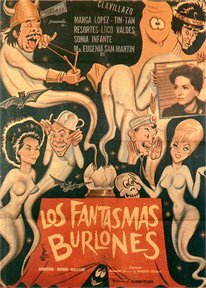
Los fantasmas burlones (1965): FOUR Mexican comedians for the price of one, mostly because all of their careers were on the downturn in 1965, along with the Mexican film industry. Clavillazo, the genius pantomimist and catchphrase delivery-system, stars along with goofy eccentric dancer Resortes as a pair of carnival mind readers/fortune tellers who accidentally conjure up two genuine ghosts: Tin-Tan (the second most famous Mexicomic of all) and his brother Loco Valdez (who most famously played The Big Bad Wolf in Mexican fairy tale movies). Tin-Tan none-too-convincingly plays an Englishman, Ludovico Churchill, and Loco is an 18th Century French dandy. These historical roles are meaningless, however, and eventually get lost in the shuffle as Tin-Tan and Loco steal suits, run amok in the amusement park and make time with Clavillazo and Resortes' girlfriends. The film is loaded with comedy musical numbers, mostly from other movies (resulting, at one point, in Resortes suddenly becoming eight years younger and losing his mustache). There's an absolutely amazing Around The World Tribute to Ethnic Stereotypes number which features Tin-Tan and Loco as, among others, stereotyped Chinamen (in Japan), Egyptians, and Greeks, and Loco performs "Witch Doctor", transforming himself at intervals into a Witch Doctor, a fey cupid, and a Nazi (!!!!). Brain-melting, Mexican comedy overload, with more catchy pop songs, low-budget ghost FX and carnival atmosphere than thirty such lesser films. You don't need to understand a word of Spanish to enjoy this, but it helps.


Labels: , , , , , , , , , ,