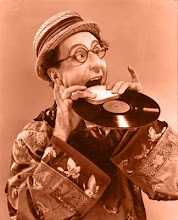
Mr. Noisy Heckler
 by Kevin Kusinitz
Anybody who’s tired of today’s movie remakes should take a look at what was going on at Columbia Pictures in the ‘30s and ‘40s. Long before people knew from “recycling,” Harry Cohn’s lieutenants in the short subjects department were in the business of using material over and over.
I never realized how prevalent it was until wandering over to the Columbia Shorts Department site last month. Summary after summary featured the descriptions “REMADE AS” or ‘REMAKE OF.” Among the movies I ordered was Charley Chase’s The Heckler (1940). Having recently watched the 1946 remake, Mr. Noisy, I thought this might make for an interesting comparison. You know, the same way scholars debate the qualities of, say, the different versions of Dr. Jekyll & Mr. Hyde. Only instead of Fredric March, I’d be studying Shemp Howard.
For those who haven’t seen either version, it’s about an obnoxious sports fan whose heckling upsets athletes to the point where they lose. A couple of goons hire him to pull this stunt so they can throw a World Series game. But when the heckler catches a cold and loses his voice, it looks like it’s curtains.
I could fill in the details, but it would only raise questions like: Why do the goons get the heckler liquored up when he’s already told them he’s going to the game? And why doesn’t the coach lock his room during his pep talk to the team? And why doesn’t the heckler lock his room? (Answers: 1. Comedians are always funnier when drunk. 2. So the heckler can walk in and upset them. 3. So the coach and the player can walk in and give the heckler a cold by putting ice cubes on his chest.)
I’ve seen enough remakes so that I was expecting the usual routine of same story, different storyteller. Not this time. Remember when Gus Van Sant directed that shot-for-shot remake if Psycho? He’s got nothing on Edward Bernds, who follows Del Lord’s original so slavishly, you’d think he just digitally replaced Charley Chase with Shemp, until you remember this movie’s six decades old. From the very first seconds – the “tennis match” sign, the spectators moving their heads back and forth in unison, the shot of the players – it
 was apparent that the directors were literally working off the same page. The dialogue, camera angles, sets, stock footage, the name of the ballplayer (Ole Margarine), the dialogue -- everything is identical. Even supporting players Vernon Dent and John Ince appear in both as a spectator and doctor respectively. If Bud Jamison hadn’t died in 1944, he’d have probably been hired to repeat his role as the guy with the broken hat. Why didn’t Columbia just re-release the original? That would’ve been the ultimate moneysaving move.
The only things I could compare – or, rather, contrast -- were the lead actors. I went into The Heckler thinking I’d prefer Charley Chase, since I tend to dislike remakes and everything that goes with them. This was one time I was wrong. While Chase gives a good enough performance, Shemp seems like a genuine heckler who just happened to be caught on camera. I’ve never warmed up to him as a Stooge, but always enjoyed his solo work, both in shorts and his supporting roles in features. He’s a far better comedic actor than I gave him credit for in the past; the way he shouts the same insults is funnier. Watch Mr. Noisy once and I guarantee you’ll yell “Watch him miss it!” at the next ballgame.
The scene that clinched it for me was when the goons ask the heckler if he plans on going to the ballgame the next day. Chase and Shemp answer in the affirmative, then imitate the sound of a (dubbed in) train whistle. Quick cut to a stock shot of a locomotive, then another quick cut to a bar, where the goons have gotten the heckler drunk. Chase merely looks tipsy, while Shemp appears stunned to have suddenly appeared in this gin joint from out of nowhere. The former is expected; the latter, inspired. It may not read inspired, but coming from a cheap, 17-minute movie, it might as well be Un chien andalou.
Ultimately, Chase’s heckler is more annoying than amusing, while Shemp’s Mr. Noisy is the kind of guy you could have a beer with – after the game. He’s a pain in the butt but a funny pain in the butt. Maybe Chase was more comfortable in his usual nice-guy roles. Yet this character seems to be the same conventioneer he played so hilariously in Sons of the Desert, so what gives? Did booze get the better of both Chase and the heckler?
See, I told you this was going to be a scholarly debate. Shemp actum per vicis quod tractus!
Labels: Charlie Chase, cinema, Shemp Howard
posted by Aaron Neathery at 9:15 PM
0 comments