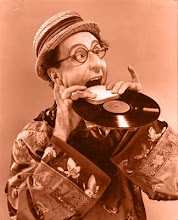
"If any team deserves to be obscured in the annals of film history, it is they.." Thus spake Leonard "**1/2" Maltin in his 1970 book Movie Comedy Teams. We here at The Third Banana shun such talk, especially in regards to acts as fascinating and peculiar as that of Mitchell and Durant.
 The Stage, 8/8/29. Mitchell and Durant and Burns and
Allen on the same bill at the Palladium. Courtesy Geoff Collins.Frank Mitchell (1905-1991) and Jack Durant (1905-1984) were mainstays of the waning years of vaudeville, a pair of loud and extremely violent slapstick comics whose act consisted of non-sequiturs and beating the crap out of one another. Creatively, of course. Squinty-eyed Frank Mitchell was the diminutive fall guy; tall and handsome Jack Durant was the guy who came up with excuses to toss him into the orchestra pit. Like Clark and McCullough before them, Frank and Jack developed their acrobatic act from childhood and gradually climbed the vaudeville ladder. Unlike Clark and McCullough, however, Mitchell and Durant's repertoire remained forever limited to knockabout antics. Their highly-polished act was spectacular enough to assure the team prime spots in glossy revues like the
Scandals and
Vanities but their one-dimensional nature would forever prevent them from becoming headliners in their own right.
Things might have been different had Mitchell and Durant made their film debut as a team in shorts. Their simple characters, acrobatic abilities, and brisk timing would have made them right at home at Educational or Columbia (Frank Mitchell did work briefly at Columbia for Jules White in the early 50s). Instead, the team debuted in a film equivalent of the stage revues they had been appearing in since the late 20s, Fox's
Stand Up and Cheer! (1934). Beloved by some, I find
Stand Up and Cheer! a bizarre yet somehow un-entertaining mess made palpable only by the presence of Mitchell and Durant. The President of the United States appoints theatrical producer Warner Baxter "Secretary of Amusement" to shake the nation out of its Depression-induced depression, the logic being that only general good cheer and novelty acts will put the country back on track. In lieu of "amusement" we get Stepin Fetchit, the terrifying Aunt Jemima (Tess Gardella in blackface), Nigel Bruce playing his usual idiot character, a penguin with the voice of Jimmy Durante (impersonated by lyricist Lew Brown?? What the-), and the wuvable Shirley Temple in her feature film debut. Yeah, that lot may be someone's idea of entertainment, but that person is not me. Mitchell and Durant appear mid-way through the picture as Senators Danforth and Small, sent to investigate the whole Department of Amusement matter as a possible waste of money. Their debut is actually a clever surprise; they begin by playing their parts as Senators straight.. and then suddenly and unexpectedly launch directly into their act, which must have caught contemporary audiences pleasantly off-guard. Their routine is a combination of acrobatic display and slapstick gags, cut through with peculiar pseudo-political speechmaking and strange one-liners ("What made pistachio nuts?" asks Mitchell).
Mitchell and Durant were memorable and entertaining enough for Fox to keep them under contract, but the studio apparently wasn't too sure what to do with them. The team found themselves quickly cast as comic relief in a series of four musicals, three starring Alice Faye and one,
Spring Tonic (1935), starring Lew Ayres and Claire Trevor. I've heard good things about them in
Spring Tonic and
She Learned About Sailors (1934), but their gag sequences in
365 Nights In Hollywood are poorly-written and a waste of their talent. Their contract must have run out in 1935 for they were at Warner Bros. the following year turning in excellent and rather uncharacteristic performances in Al Jolson's last hurrah
The Singing Kid. Mitchell and Durant appear as Babe and Dope, two of Jolie's radio gag writers, and in place of the usual acrobatics (aside from a brief backflip for Frank) are nicely written and beautifully performed running gags. "Hold out your hand!" demands Jack after Frank pops off a lousy pun or makes a silly suggestion, and then ignores the hand completely, instead dumping a vase over Frank's head or slapping his face. At the end, Frank has finally had enough. "Hold out your hand!" he growls at Jack, and then slugs him squarely in the face.
Mitchell and Durant's violent wise-guy comedy fit neatly into Warner's house style, so it's strange that they weren't kept under contract. Instead,
The Singing Kid was their swansong as a team in movies. They split in 1938, so presumably they spent a few final years on the West Coast nightclub circuit. Frank Mitchell quickly bounced back into movies in 1939, staring with small uncredited roles, and then hitting his stride in 1941 as "Cannonball", a comic sidekick in Bill Elliott and Tex Ritter westerns at Republic (
3rd Banana contributor Nick Santa Maria met Frank Mitchell briefly in the 1980s and claims that Mitchell was positive he was going to be remembered solely as Cannonball). Durant left Hollywood and returned to Broadway in the original production of Rodgers and Hart's
Pal Joey.
 The Great One and Florence Rice are wearing about the same amount ofeyeliner in this odd, odd publicity photo. And, hell.. Borrah Minevitchand his Harmonica Rascals, too?? I must see this movie!
With Abbott and Costello's smash hit
Buck Privates in 1941, comedy teams were once more hot stuff in Hollywood. Jack Durant, who had resumed his film career in 1942 with the Ray Bolger service comedy
Four Jacks and a Jill, played Abbott to a young Jackie Gleason's Costello in
Tramp, Tramp, Tramp for Columbia that same year (anyone seen this?). Two years later, Frank Mitchell turned up in the Republic musical
That's My Baby! with a new partner, Lyle Latell, who would become best known as Pat Patton in RKO's
Dick Tracy features. Again, I haven't seen this and can't imagine who played the straightman. While Durant and Gleason were undoubtedly Columbia's artificial brainchild, Mitchell and Latell must have been a legitimate stage team because they returned the following year in
George White's Scandals for a different studio, RKO. Any information would be greatly appreciated.
In 1943, Jack Durant appeared as Gogo Martel in Orson Welles'
Journey Into Fear which, despite Durant's solid performance, clearly counted for little as he then vanished from the screen (apart from tiny cameos in
No Orchids for Miss Blandish (1948) and
The Bellboy (1960)). Frank Mitchell, however, kept plugging away in Hollywood with ever diminishing returns, eventually turning up in small roles on TV. There are two odd codas to Mitchell's career. In 1976, he directed
Blood Voyage, his only feature. Again, I'd love to know how
that came about. Three years prior, he joined Curly Joe DeRita and former Ted Healy stooge Mousie Garner as one third of "The New Stooges", a Three Stooges spin-off act that was booked at amusement parks for a couple of months. Were
you lucky enough to have caught their act? If you were, please clue me and our readers in. The idea of Joe DeRita, Mousie Garner, and Frank Mitchell slapping each other around on-stage at some theme park is the stuff my dreams are made of.