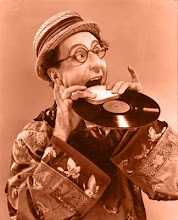
Sunday, January 13, 2008

Dead Old Comedians

by Geoff Collins

The dreaded IRS strikes again! Fear not - this has nothing to do with taxation. I refer to Insufficient Research Syndrome, that embarrassing condition that banishes even the most diligent writers and researchers to Outer Gaffe-Land, due to their reliance on previously-published misinformation. In an article on the deliciously perverse Houston Sisters (see our Archive) I stated that Billie died in 1955, purely because I trusted an earlier researcher. It turns out that the poor lady lingered on, in poor health, for another eighteen years, so 1973 would be a more likely date, based on page 156 of Don't Fence Me In, by Renee Houston (Pan Books, 1974). But don't quote me!

Speaking of quotes, this is from Tom Hickman's excellent book about BBC radio during World War Two, What Did you Do in the War, Auntie? (BBC Books, 1995), page 54:
"Wartime broadcasting revived the careers of a number of fading troopers like Marie Lloyd, Little Titch [sic] and Dan Leno."
Wow! They must have needed some reviving. By mid-WW2 Tich had been dead for about fifteen years, Marie for twenty and Dan for forty. At least he's right about the "fading". I sent an e-mail to Mr. Hickman along the above lines but received no reply. Hopefully by now he's not in need of the same kind of reviving.

Here's my guess at what happened: in the course of his research Mr. Hickman must have waded through endless copies of Radio Times. He probably found details of one of Leslie Baily's Scrapbook programmes and didn't realise that the list of historic names were on old records instead of the real thing. It's true that some of the old music hall stars did get a brief shot at a comeback, notably the ebullient Cockney singing comedian Harry Champion (1865-1942; dates double-checked!) All movie clips of Mr. Champion seem to have been lost. He's nowhere to be found on www.britishpathe.com, and the portions of his act that he filmed for British Lion seem to have vanished along with most 'thirties British Lion material. (Readers, now's your chance to prove me wrong again - and while you're at it, find Sandy Powell's feature films!) At least Mr. Champion made around a hundred and sixty recordings, all of which capture his breathless energy as he rattles off songs about food and drink. One of my favourite quotes of all time comes from Kindly Leave the Stage! by Roger Wilmut (Methuen, 1985), page 139, and it gives us a flavour of what's been lost by the absence of film of Harry Champion. This is acrobat Bob Konyot describing Harry's appearance at the Shepherd's Bush Empire in the early part of the war:
"Gracie Fields was supposed to get £500 a week - she was the highest paid star; our springboard act was getting around £75 a week; and some of these old-timers like Harry Champion were lucky if they could pick up £40. I went down to see his act; they played his signature tune - and no Harry Champion. They played it a second time - no Harry Champion. They played it a third time - still no Harry Champion; the boss of the show said, "All these old-timers do that, to create an atmosphere before they go on." And it was true that Harry Champion went on that stage - and Whoomph! - you know, that man couldn't sing, that man couldn't dance, he looked like a cabbie and he danced like Donald Duck... he couldn't do nothing; but he had the audience in the palm of his hand, and they loved him every minute of his act. He didn't do anything, but he was one of the greatest performers I've ever seen."
For an idea of Harry in action, his 1940 record of Any Old Iron can be heard on www.britishmusichallcds.com.

Sorry, readers, no bells and whistles this time. The recently-recovered clip of Dan Leno - "An Obstinate Cork" - in the form of a Kinora flip-book, has yet to be issued to the public. (Why??? By "recently", I'm talking about seventeen years) Two of Dan's records can be enjoyed on rfwilmut.clara.net, and there's a fascinating and thorough biography on billgreenwell.com. The glorious Marie Lloyd is sadly under-represented by nineteen scratchy 78s and a short silent clip of about 1920 (from the Topical Budget newsreel?) in which she looks frankly decrepit, totally worn-out at fifty. Little Tich's thirty 78s are mostly thudders. Unlike his contemporary Dan Leno, he comes across as self-conscious and a bit smug; but his immortal Big Boots dance was filmed twice, the most easily-accessible version being on www.britishpathe.com (clip number 2845.04). The 1900 version Little Tich et ses Big Boots, filmed in Paris by the photographer Clement Maurice, has been cited by Jacques Tati as "a foundation for everything that has been realised in comedy on the screen". Praise indeed!

(In case any Will Hay fans are reading this, the Big Boots dance in Those Were the Days is performed by Sammy Curtis. He's a bit too tall but at least he was still alive!)

By now you may be wondering "what's the purpose of all this?" but to elaborate on Tati's point, all styles of comedy have to start somewhere. It's all about influence: in the baggy-trousered grace of Little Tich we can see Charlie Chaplin; Harry Champion's chirpy optimism is discernible in Tommy Trinder and that spectacular peacock Max Miller; Marie Lloyd has been portrayed with consummate ease by Barbara Windsor and, most recently, Jessie Wallace; and Dan Leno's plaintive London-Irish surrealist patter, decades ahead of its time, is a direct forerunner of the grotesquerie of Max Wall and the Goonery of Spike Milligan. I'd happily trade any number of 1940s Columbias by Certain Psychopaths Who Shall Remain Brainless, for more - or indeed any - film clips of Leno, Marie Lloyd, Tich or Harry Champion, or the other early stars who departed too early or left us too little. But even if their work only exists in rare bits and pieces, let's enjoy what we have.

Labels: , , , , , ,

Thursday, December 21, 2006

Ted Healy: In Memoriam

In his own time, Ted Healy's biggest problem was Ted Healy. Ted was an out of control actor before it became fashionable. Highly talented and blessed with the ability to woo a tough crowd in record time, Ted also drank to excess, gambled, womanized, fought, and was even a bit of a pyromaniac, reportedly carrying a hip flask full of kerosene. He was a true eccentric, given to whims and not at all afraid to make a scene in public if the mood struck him. He could be generous and fiercely loyal to his friends, but his hair-trigger temper repeatedly landed him in hot water and, in several instances, undoubtedly set back his career. 69 years ago today, the risks of living dangerously caught up with him and he died of liver failure following a drunken brawl at the Brown Derby. He was only 41.

Today the problem with Ted Healy is his stooges. If they had never split for the cozy, atavistic comforts of Columbia, if they had never become baby boomer pop culture icons, if they had remained the rough-and-tumble goons of their vaudeville days with Ted, then Ted himself would probably be much better regarded today, probably as exactly what he was; a top-notch, talented and extremely innovative comedian who died the very peak of his abilities. But that isn't the way it worked out. If Ted Healy is remembered at all, it's never just Ted that most people remember, it's Ted Healy and his stooges.. or Stooges, rather. His best work in film, his two pictures for Warner Brothers, remain sadly obscure, especially in contrast with the 190 bite-size and comfortably similar Stooge shorts that have been TV mainstays since 1958. Ted's only starring feature, Soup To Nuts, remained largely unseen until 2005 when it was released on DVD with a sleeve featuring a huge picture of the Stooges. Them's the breaks.

Don't get me wrong.. I love the Stooges. I grew up with the Stooges. But the unbridled hate so many die-hard Stoogephiles feel towards Healy, witnessed in full during my time as webmaster of tedhealy.com, saddens me. There's certainly no poetic justice in Ted's fate unless you accept the fairy tale notion that the Howard, Fine, and Howard spent their formative years toiling anonymously, propping up an ungrateful, talentless ham. This handy and highly marketable myth aside, the real problem is that the dynamic between Ted Healy and his stooges is innately divisive. The comedy emerges from that division. There is no real common ground to be found between Healy's eccentric and off-handed cynicism and the Stooges' classic clowning, nor should there be. That's why Moe, even as "leader" of the Stooges, is still a stooge (whether he knows it or not), whereas Ted, when his role as leader is literalised in films such as Meet the Baron, is simply a world apart, a tinpot tyrant, and there's no doubt whatsoever that he is in charge. When an audience accepts the complete package, as they did in the 20s and 30s, that innate divide between the cynical proxy and the clown (or clowns) is gold. But when an audience favors one side over the other, it's poison. To someone weened on the Columbia shorts and incapable of seeing beyond them or contextualizing them, Ted must come across as the worst kind of interloper and, as such, is apparently worthy of the kind of scorn usually reserved for serial killers and politicians. A pity.

The cynic and the clown; if Ted Healy didn't invent the formula, he certainly popularized it. Milton Berle brought it lock, stock, and barrel into the television age, with Arnold Stang regularly playing stooge and Berle playing the wiseass go-between. Martin and Lewis became the hottest nightclub comedy act in history with it before Paramount pissed it all away by repeatedly casting Dean as some kind of humorless villain. Even today, you can see a down-to-earth equivalent of the dynamic between David Letterman and many of his guests. At least Letterman can move on to the next guest. Ted is currently locked in limbo with his Stooges, his post-stooge film work remaining largely unseen or ignored. Unfortunately, it's in that work where Ted Healy really is, the gruff, scene-stealing character actor who could handle both comedy and drama with flair. By 1937, he and his writers at Warners had even discovered ways to make you care for the guy (think W. C. Fields). Everything pointed towards a brilliant future for Ted. Given the trajectory that American showbusiness actually followed, Ted Healy would have been ahead of the curve every step of the way, from the sharp cynicism of wartime comedy to the dawn of "vaudeo" where Ted's quick wit and ability to work an audience would have certainly given Uncle Miltie a run for his money. As far as I'm concerned, Ted Healy will remain the greatest "what if" of classic comedy, and I'll be drinking a 60-proof toast to his memory this Christmas.

Reader EastSide has been kind enough to draw my attention to these vintage Healy clips from YouTube. First, 6 minutes and 8 seconds from Plane Nuts (1933), the second most complete record of Ted's vaudeville act (the first, and superior, being the recreation of the act in Soup To Nuts (1930)).


Here's a nice clip of Ted hitting on a couple of unbilled Chinese women in a clip from Myrt and Marge (1933). They're singers, but I have yet to discover their names. Myrt and Marge is easily the finest hour for Ted Healy and his stooges as supporting castmembers in a feature. MGM never handled the team nearly as well as Al Boasberg and Universal. Ted's rueful glare at the camera at the film's close is one of my all-time favorite Healy moments. Brilliant.


Labels: , , , , , , ,

Sunday, November 05, 2006

A Gottle of Geer

by Geoff Collins

Sensation! Peter Brough saved Eric Sykes' life!!! This astonishing revelation comes from Sykes' recent autobiography If I Don't Write It, Nobody Else Will. In November 1951, Sykes, not yet a comedian himself, was the scriptwriter for Educating Archie, the odd radio phenomenon that made huge star(s) of sloppy-lipped vent Brough and his dummy, cheeky schoolboy Archie Andrews. Sykes was suffering from persistent agonizing headaches, but doctors were unable to pin this down to a specific ailment. A chance phone call from Brough - to whom Sykes described his painful condition - prompted Brough to send his chauffeur-driven limo to whisk Sykes off to a Harley Street specialist. An acute mastoid infection was diagnosed; if left untreated, Sykes would have been dead within three days. So in spite of all we've said about Brough and his limited abilities, he saved the life of Eric Sykes, who is still around today providing glorious comedy as well as some stunning straight acting (as in The Others). Well done, Groughie! Take an apple out of the barrel, as we say over 'ere.

This may be a good place not to recommend Eric Sykes' Comedy Heroes. The title is irresistible but beware! It's one of the most inaccurate books ever written. He laments the "fact" that Buster Keaton is forgotten and that his films aren't being shown anywhere (!!!), and spectacularly misquotes Rob [sic] Wilton's Home Guard sketch; and a full-page photo of "Jimmy Edwards" is actually Paul Whitsun-Jones. There's so much wrong with this book that it depresses me to think of it still being in circulation, misleading all those potential comedy fans. Where were your researchers, Eric?

While on the subject of ventriloquy, all four of our American readers will be familiar with spasm-jawed Edgar Bergen, the man who inspired "Archie" by proving that ventriloquism works well on the radio; but let's take a few moments to reflect on some British ventriloquists who came along in the wake of Brough's success. You couldn't turn on a British television in the sixties without encountering some rictus-faced charmer with his arm stuck up a block of wood. Here's a selection of some of the best from this Golden Age of Venting:

Bobbie Kimber. A very odd act. When glamorous Bobbie appeared on Opportunity Knocks in the 1970s, returning to showbusiness after a long period of inactivity, host Hughie Green asked the audience dramatically "Is it a man - or a woman?" In fact Ronald Victor Robert Kimberley was a man who chose to do his routines, with a full-sized dummy and a more conventionally-sized "sit-on-the-knee" one, in full drag. No explanation was ever given for this, but Bobbie was a convincing "woman" and a good technician. Maybe he felt the act worked better that way; or maybe he was just a tranny who'd found a wonderful excuse for dressing up. Either way, he was years ahead of his time, one for Aaron's collection of Strange and Wonderful Acts. Good for you, Bobbie.

Saveen and Daisy May. Another strange man. I saw Albert Saveen's act in a summer show at Hastings in the sixties. Schoolgirl "Daisy May" was his main dummy; she had her own bank account and a private telephone number. Roy Hudd has often recounted that Daisy May once answered the telephone when he rang up to speak to Albert; "she" engaged Roy in some idle chit-chat and then said "Albert's not in - I'll ask Mr. Saveen to phone you back." Sure enough, later on Saveen called Roy: "Daisy May says you rang earlier."

Despite these quirks, Saveen was a skilful, wily old variety vent. Aside from Daisy May there was, as I recall, a deliberately unconvincing duck dummy (Charlie Quack-Quack) and a live dog, probably a small terrier of some sort. They don't have acts like that any more!

Neville King. Now we're talking. Neville was hilarious. His main dummy was an irascible old cloth-capped Granddad who violently resisted all attempts to put him "gack in the gox" - culminating in a shockingly realistic altercation which left Neville breathless and disheveled, holding the lid down as the muffled voice of the old sod hurled abuse at him from inside the container.

Dennis Spicer was all smiles and charm, a huge hit at the 1964 Royal Variety Performance; and he may have been the most technically accomplished of all. He had enough elan to select two members of the audience and use them as living dummies, "working" them with a tap on the shoulder. Tragically, Dennis was killed in a car crash shortly afterwards; his dummy, in the car with him, remained intact.

And finally my personal favorite: Terry Hall. Facially similar, in his toothy, smiling way, to Dennis Spicer (to such an extent that a member of the public once asked him "Aren't you that ventriloquist who was killed in the car crash?") Terry started his career with Micky Flynn, the Irish Dummy; but he found lasting fame with a later creation, Lenny the Lion. As a boy I absolutely adored Lenny. Like Snagglepuss and any number of other Lions, Lenny was obviously based on Bert Lahr, complete with American accent and camp hand-flapping mannerisms ("Well!") but he was genuinely appealing. Terry and Lenny are completely forgotten now, but not by me. I also saw them in a Hastings summer show. Happy memories!

We musn't close this little survey without a mention of northerner Arthur Worsley who "said nothing" and looked glum while the dummy subjected him to a torrent of insults; or Roger de Courcey and Nookie Bear; or Ray Alan and his immortal Lord Charles, an inebriated, monocled aristocrat with more than a touch of Fred Emney; or Archie Andrews himself. As reported earlier in our pages, Archie's been sold by the Broughs, for £34000, to a young ventriloquist, so we may yet see a revival of this unique and often derided form of entertainment.

For fans of archaic ventriloquy, the Pathe website has some fascinating clips of Arthur Prince and Jim, as well as a "pre-Archie" Brough; even as early as 1943 he was hiding his lips with a cigar...

.... all of which brings us to dear old Yorkshire comedian Sandy Powell, who in his last years devised a priceless routine as a hopelessly inept military ventriloquist. This was Sandy's revenge on a succession of crappy vents who populated his touring shows over the years. Wheezily spluttering through a huge false moustache, he allowed his hand to become visible through the dummy's neck-hole. "Oh dear - I seem to have given the game away!" God bless you, Sandy. It needed to be done.

More on this subject later!

Labels: , , , , , , , , , , , , , ,

Friday, September 15, 2006

Vaudeville Ends und Odds

A couple of free classic comedy finds for you this week. First, a stash of ancient Weber and Fields recordings on archive.org. Joe Weber (right) and Lew Fields (left) were THE American comedy team at the turn of the century, and the unprecedented fame they enjoyed probably remained unequalled until the arrival of Laurel and Hardy. Weber and Fields, who began performing together in the Bowery in 1877, established a standard for crosstalk routines that was very much alive through the 1950s, thanks to Abbott and Costello (whose con-man v. patsy dynamic directly reflects that of W&F) and the unsung comics of the fading burlesque scene. Their brand of broad "dutch" dialect comedy may not read as particularly funny today, but there are some good gags and razor-sharp timing to be found in these nearly century old tracks. Incidentally, Weber and Fields made most of these recordings in 1912 after they had reunited following a contentious and highly-publicized 1904 split. They were still active in semi-retirement through the early 1930s, mostly in radio.

And I never thought I'd find this online. Courtesy These Records Are BenT!, the original 1970 cast recording of Minnie's Boys starring Shelley Winters. I don't mind telling you, this isn't quite my cup of thing. It's one thing to read a load of stale half-truths about the Marxes and quite another to hear them dramatized and set to music (produced by Enoch Light!). But I have to admit a fondness for Where Was I (When They Passed Out Luck), a song for the Marxes in which they enumerate their various personal strengths. You just know the actors are sitting on a fake curb while, behind them, some guy dressed as an Italian fruit merchant (with a huge black mustache) silently hawks his wares to passerby. At the end of the song, he probably shoos the Marxes away with a line like "Hey, you-a keeds! You getta way from-a my fruit stand! You-a scaring away my customers!" Chico steals an apple from the cart as the curtain falls.

Labels: , , , ,

Monday, September 04, 2006

Ted Ray: Fiddling and Fooling

by Geoff Collins

August 29 1974, the Playhouse Theatre, London. A pre-recording of the radio show Does the Team Think? and yes, dear readers, I was there, thrilled at the prospect of seeing four of Britain's greatest comedians in action: Ted Ray, Arthur Askey, Cyril Fletcher and "Professor" Jimmy Edwards. Pre-arranged members of the audience each asked the team a question which the veteran comics then proceeded to answer, hopefully in a lively and amusing way. This particular edition was finally broadcast over six months later, on March 24 1975, and to be honest it hasn't worn well. The actual recording lasted for over an hour, but the final cut is a thirty-minute programme with - thankfully - much of Edwards' boorish filth edited out. (After one particularly obscene comment he signaled a "cut this out" scissors-like mime to the boys in the control room.) Edwards, Fletcher and Askey droned on endlessly and, to be fair, occasionally amusingly; Ted Ray could hardly get a word in. But fifty years' experience as a razor-sharp ad-libber had prepared Ted for such situations. He lets the others yap on and then, every now and then, he crackles in with a one-liner:
Jimmy: ...no, well, you see, it would be nice to be perpetuated in some way...

Ted: Well, you can be in Denmark of course !
and again...
Cyril: My first professional engagement was to perform to the ladies' night of the Hampstead Lacrosse Club - and I got twenty-five bob.

Ted: Was that net?
Ted's best gags were just there. Like a virgin birth, from nowhere. No apparent thought process. Here's one from twenty years earlier, quoted in Bob Monkhouse's Crying With Laughter. The occasion was the warm-up prior to a broadcast of Calling All Forces, with Diana Dors as the Mystery Guest:
Leslie Bridgmont: We've got a smashing mystery glamour star on the show today, boys and girls, who deserves your applause, so please give her a big warm round.

Ted: Why not? Everything else she's got is big and warm and round.
The audience fell about. Bob wrote that ad-lib down, gave it to Ted in a later broadcast and Ted never realised he'd actually "written it".

Ted Ray was one of my heroes. In the early 70s in Britain he was the Maestro, a frequent guest on radio and TV panel games - such as Jokers Wild - where he dazzled the audiences with his ready wit. "Give me any key word and I'll give you four jokes..."

"Ted Ray" was actually Charles Olden, born in Wigan on November 21 1905. Note the date, readers; Ted's year of birth is often given as 1909, but the actual date is in Who's Who for 1955 (in later editions it conveniently disappears!) and in his autobiography Raising the Laughs he states that in April 1926 he was twenty, which is perfectly correct. Initially he reversed his surname and was Nedlo the Gypsy Violinist; then when he realised that he could be funny as himself, in an ordinary suit, just telling jokes in between quick bursts on the violin, his new agent George Barclay suggested (insisted!) that he should have a snappy new name to fit his snappy new image. Leafing through his pocket sporting diary he came up with the name of a half-forgotten golfer, the winner of the 1912 Open: Ted Ray. Barclay liked it immediately.

Ted's "bill matter" was also a stroke of genius: "Fiddling and Fooling". As Michael Kilgarriff has pointed out, it tells you everything: Ted Ray is a violin-playing comedian. And it's worth mentioning at this point that although Ted was born in Wigan and brought up in Liverpool, he was never a "north-country comedian", one of those gormless sub-Formbys inflicted on the British public from time to time. Good job too - or we wouldn't be discussing him here.

Ted was successful for several years on the variety circuit. It's been claimed that his first movie was Elstree Calling, but this was made in 1930, before he was even "Ted Ray". I suspect that Ted's been confused here with Tommy Handley; his movie debut is probably Radio Parade of 1935, although he barely registers at all. It's about 97% violin and 3% jokes; he's also there under false pretences as his first broadcast wasn't until 1939 - and this was almost a disaster as the recording equipment for the repeat broke down and he had to do the same act again in front of the same studio audience. Fortunately he was crafty enough to let them in on the secret and they reacted appropriately in all the right places.

It wasn't until 1949 that Ted got his own series. Tommy Handley, beloved star of ITMA, had died and Ted got Tommy's Thursday night spot. Another stroke of genius: Ted's pal, producer Sidney Smith, came up with the most perfect title of all time - Ray's a Laugh. With its catchy theme tune and an ITMA-like cast of crazy characters including many played with quite unnecessary integrity and realism by Peter Sellers, they were off to a good start; the first series ran for a record sixty-five weeks straight through. But there was only one problem...

"Ray's a Laugh really is crap" writes Roger Lewis in The Life And Death of Peter Sellers; and I hate to admit this, readers, but it's true. The four episodes issued in the BBC Radio Collection in 1990 prove it. Apart from Ted's opening monologues, and the brief sequences where Sellers brings his cardboard characters to vivid life, it's uninspired, witless and a bit desperate, clear evidence of hack writers forced onto a weekly treadmill. The show improved a bit when the ghastly musical interludes disappeared and Ted's domestic sketch with his "wife" Kitty Bluett was expanded to the full half-hour, but even this now sounds irritating and restricted, far from either the naturalistic downbeat realism of Hancock or the fantastic extremes of the Goons. But it was popular enough to run for twelve years. Ted's finest hour was still to come.

He was always loved by the public, and for a brief moment in the early 50s he was a genuine movie star, although his film career never really took flight. The "Red Peppers" sequence of Noel Coward's Meet Me Tonight has Ted at his best - and in Technicolor - in a vignette about a broken-down song-and-dance team; but Ted's most frequently-revived movie is Carry On Teacher. The final scene, when headmaster Ted decides to relinquish his new job because he realises how much his pupils love him ("See you next term...") is genuinely moving and real, the most heart-stopping moment in all the Carry Ons because Ted plays it absolutely straight; pure sincerity and warmth. He could have been a fine dramatic actor, but apart from one more quickie for Peter Rogers - Please Turn Over, a nice little movie, but no classic - that was it. Sid James got the Carry Ons and Ted went back to radio.

Ray's a Laugh and its successor Ted Ray Time ran until 1961; surviving bits of his TV series from the mid-50s show him in fine "fiddling and fooling" form, but by the 1960s he'd slipped a bit. Fortunately the nostalgia boom of the 70s and the celebrations of "fifty years of the BBC" helped the British public to realise how good he really was. It's a recurring trait of this nation not to appreciate national treasures until it's almost too late. On Jokers Wild he held his own against the up-and-coming new talent, and on Does the Team Think? he outclassed his contemporaries, when they were gracious enough to let him, with beautifully-crafted ad-libs.

Sadly Ted was involved in a drink-related motor accident in 1975, at which point his wife Sybil inadvertently revealed his carefully-hidden True Age: "He's too bloody old to drive - he'll be seventy in November." Ted was badly injured and it sent him into a period of deep depression. He'd partly recovered from this and seemed to be bouncing back - he was on great form at a tribute lunch for Jimmy Jewel - but he died on November 8 1977, aged nearly seventy-two. The London Evening News gave him the full front page. They called him "the computer comedian" because of his astonishing ad-lib facility, but this is a bit unfair. Ray's a Laugh may have been mechanical but Ted never was. In his autobiography, Ted generously speaks of Robb Wilton's warmth: "Robb Wilton has it in greater measure than any living comedian"; but these words could equally be applied to Ted himself.

One more example, from the Playhouse Theatre, August 29 1974. Mr. John Harvey asked the team if they thought there should be a marriage test before a marriage license.
Jimmy Edwards: No, you see, both sides...both sides of the happy couple, the male and the female, should have separate tests because, I mean...

Arthur Askey: Well, you can't go in the room together. It'd be rude!

Jimmy: [ignores this altogether] They're required in the marriage to do different things, like you'd have an egg-boiling test for the lady...

Ted: Three minutes hard?!
That was Ted Ray, England's finest stand-up comedian. Ladies and gentlemen, boys and girls, goodnight.

Labels: , , ,

Friday, June 23, 2006

Mexican Hayride "too sexy for GIs"


Bobby and Luba Malina in Mexican Hayride. Luba
was one of the only original castmembers to appear
in the 1948 Universal film adaptation. Click on the
thumbnails for full-sized images.

I found this on eBay a couple of weeks ago. It seems that some portions of Bobby Clark's 1944 Broadway hit Mexican Hayride were considered so salacious that the USO banned it as a camp show for GIs overseas. That's right.. Civilians could see Mexican Hayride whenever they felt like it, but not servicemen getting their asses shot at. Lord knows what the moral guardians at the USO got their knickers in a twist over. Universal certainly had no problem converting Herbert and Dorothy Fields' play into a toothless, Cole Porter-less, kid-friendly Abbott and Costello vehicle. Considering that the USO lost Bobby's collection of skits that very same year, I doubt he harbored many warm feelings for that particular institution.

Labels: ,

Friday, June 16, 2006

Happy Birthday Bobby!

In honor of Bobby Clark's 118th birthday, I'm posting these two images from the collection of Mike Brick, nephew of Paul McCullough, who has graciously consented to their use. These photos are taken from Paul's mother's personal scrapbooks of her son's career, and there's plenty more where they came from. A huge overhaul of The Clark and McCullough Database is now in the works so watch this blog for future announcements.


Clark (right) and McCullough (left), circa 1913, in their vaudeville act Much Ado About Nothing, a variation on their circus routine in which they attempt to put a chair on top of a table. Bobby and Paul had already been comedy teammates for thirteen years at this point! Bobby's greasepaint eyeglasses, of which you can seen an early variation here, had their origins as a part of his traditional clown's whiteface makeup. The putty noses and whiteface would be gone by the end of the decade.


Clark and McCullough as we know and love them, seen here in a publicity still from their RKO short Hokus Focus (1933).

Labels: , , ,

Saturday, May 13, 2006

Keep It Going Till we Get There

by Geoff Collins

The Marx Brothers are on a fire engine, racing through the city streets. As they pass a genuine fire, Groucho yells "Keep it going till we get back!"

It's a wonderful gag, and writer Joe Adamson has expressed quite valid regret that it never made it into the final version of the much-rewritten A Day At the Races. But thanks to the gently repetitive nature of classic comedy, wherein gags are often half-remembered and re-cycled, we've managed to locate three earlier variations. Maybe, dear readers, you can provide some more.

In the 1935 Vitaphone short His First Flame, fire chief Donald MacBride has forbidden any fires to take place because the fire station is being used for Shemp and Daphne's wedding. A weedy Skelton-like fireman (Fred Harper??) answers the phone. There's a fire. He informs the chief but is bawled out. Back on the phone to the distraught caller, he says ""Well, keep it burning a little while longer. Yeah, yeah....I tried to tell him but he wouldn't listen...." Naturally it's the chief's house that's on fire.

Several years earlier, another barely-competent fire chief, Robb Wilton, has his opening monologue interrupted by a frantic woman (Florence Palmer) whose house is burning down. After some attempts at helpful pleasantries ("Turned out nice again, hasn't it?") Robb endeavours to summon his lads via his archaic speaking-tube. He sends Flo back to the fire: "Don't wait now, lady, just slip along - ask 'em to keep it goin' a bit, will yer?"

Robb filmed his fire station sketch for Pathe in 1934, recorded it on a Sterno 78 on September 24, 1931 (see www.pavilionrecords.com) and was performing it for several years before this. But we have an earlierversion... much earlier.

It's a tricky business, writing about the great comedians of yesteryear. There's usually somebody still living who remembers your subject, and they can say "No - you're wrong! He wasn't like that at all!" In the case of Dan Leno, no such problem arises. Dan was born on December 20, 1860 and died on October 31, 1904. He's been dead over a hundred years. Yet in a curious way it seems as if he's still around, haunting us. He's certainly supposed to haunt the Theatre Royal, Drury Lane (he was the Phantom of the Operetta). Stanley Lupino, who was into spiritualism, always maintained that he saw Dan's ghost. And Dan himself, in his photographs, has a haunting, haunted look, quite unsettling. You know that this man was no run-of-the-mill comic.

Dan Leno was considered to be the greatest music-hall comedian of the late nineteenth century, the Funniest Man on Earth. He was a quirky little London-Irish sprite, crumpled and sometimes mournful but always eager, alert and resilient. A tiny Milligan, forty years ahead of his time, his material often wandered off into completely unexpected areas which must have baffled the more prosaic members of his audience. He was praised by contemporary writers such as W. MacQueen Pope whose florid, anecdotal excess makes him the most appropriately named writer in the history of literature. But where's our hard evidence? Where's the living Dan?

The good news is: Dan made some films. The bad news is: none of them exist. Dan was around at the very beginning of the film industry, long before "preservation" was even considered. The early films were ephemeral and disposable; any survivals from this early date are purely accidental. A brief sequence was recently unearthed, showing Dan and his wife Lydia having fun at a garden fete. It's in the form of a portable Kinora "what the butler saw" paper flip book: a miraculous discovery - but not really representative.

So here's some more good news: Dan made nearly thirty recordings. But the bad news is: they're over a hundred years old, very scratchy and recorded at bewilderingly inconsistent speeds. Before 78 rpm was recognised as the most effective speed, it was every man for himself. Dan's record of "Going To the Races" (Gramophone and Typewriter GC2-2808) was made at about 65 rpm, as I discovered when I first played my battered old copy at 78 and got an incomprehensible high-pitched chirping. I had to hold my finger on the turntable to find out what it was all about.

More bad news: Dan wasn't happy with the primitive recording process, specifically the lack of an audience ("How can I be funny into a funnel?") so there's always a slight self-consciousness. Good news: when a record's a hundred years old, this hardly matters. We're lucky to have anything by Dan Leno; and as the record industry was in its infancy, there are few retakes and all the little fluffs are left in. For example : Dan usually starts and finishes with something resembling a brisk little song, as a framework for his character patter. Here's the first line of the published chorus of "The Beefeater":

"It's a splendid place to spend a happy day..."

On Dan's record "The Tower of London" (matrix 1129) this is what he sings :

"For it's a splendid time to see the happy hour..."

... so the next line doesn't rhyme. Annoyed at being caught off guard, right at the end of the record Dan says "No!"

Dan's very first record was "Who Does the House Belong To?", made at the Maiden Lane offices of Gramophone and Typewriter in November 1901. After a quick piano-accompanied chorus of the song, he launches into a monologue about some wonderful property he's just bought; it gradually becomes apparent that the place is a total wreck. Unfortunately the record runs out before he's finished, and clearly he's not pleased when the engineer points this out.

Dan: .... there's a little bit of garden at the bottom, you know, and I think a bit of garden looks lovely. It runs from the house...down to the river. The river's at the bottom of the garden... one month out of the year. The rest of the time, the garden's at the bottom of the river. Because the river...like, er... flows. It's, er, really the gasworks, the overflow from the gasworks, that's what it is. But it looks pretty when the sun shines on it, with all the pretty colours. But it's , er, through the wife that I bought this other house, that I haven't paid for. She came home one day, and she said, er..."why pay rent?" "Well" I said, "darling, I don't know that we have been very guilty up to the present." She said, er..."Read that", and I read it. And it said "Money advanced...without security." I said "well, that'll suit me down to the ground." [pause] [to engineer] Is that it?

Engineer: [distant undecipherable mutterings]

Dan: Chorus ?

Engineer: [more muttering]

Dan: Suit me down to the ground.

Engineer: [mutter mutter]

Piano accompanist: [starts to play the chorus again, then stops. More muttering as the record runs out]

How rare is this? A fragment of an Edwardian argument, captured forever.

Still more good news: nineteen of Dan's recordings, oddly including the sequel to "Going to the Races" (02001) but not the original, are available on CD from www.musichallcds.com. The sound quality is excellent. Every word is audible and they all seem to have been transferred at about the correct speed, which is not always the case in reissues of ancient material; so we can experience the pleasure of Dan's ramblings as "The May Day Fireman", in which Dan's voluntary fire brigade appears to be run with just as much efficiency as Robb Wilton's. Watch out for a line we discussed earlier!

You know, when you start a thing like this, there's a lot of trouble occurs. You know, I told the four boys with me...we've been out of work for over a twelvemonth, because they pulled the house down where we used to stand at the corner...but I told them, I said, we can make a lot of money by being a small fire brigade. I said, I'll pop up and see the superintendent. So I went up, and I said to 'im, er...he was in his office, I said, er....my idea was that we could be of some assistance. I said, erm...course, er, there was only one fire brigade in the village, that was his. And if a fire broke out at both ends of the village, it'd be impossible for him to squirt from one end to the other. So I...I told him, it was my idea, I said, we could be of some service, I said, a sort of little aide-de-camp brigade, I said, and if you had any little fires which you didn't want to attend to, I said, we can pop round and keep 'em going until you come up, you see. Course, he could see me idea, a very nice man he was, he never answered me. And I waited for about a half an hour outside. And, er...you see, my idea was this: not so much the fires...as the salvage. I said, we can, I told the boys, I said, we could pop round, while the fire's on, and look...look for salvage, er, see? Or, I said, we could go before there's a fire and find a bit of salvage somewhere. Or I said, perhaps in the middle of the night we could go... into houses and look round and make ourselves acquainted so that if there's a fire we, er, don't come up as strangers. So Butterworth turned round and said "Why not be burglars?" Now, you know, Butterworth's got no brains....

The justification of petty dishonesty is reminiscent of Will Hay and his equipment-stealing crew in Where's That Fire? But Dan's record was made forty years earlier; and there are no obvious "music-hall jokes". He performs the whole thing conversationally, in character, in his crisp "London with a dash of Dublin" voice. It's still funny today. Well, I think so, anyway.

In 1899 there appeared "Dan Leno - His Booke", a semi-autobiographical fantasy apparently written by the man himself, and full of the same off-at-a-weird-tangent material as the records. When a truncated, inaccurate reprint appeared in 1968, a 99-year-old hack called Tom C. Elder came out of the woodwork and claimed authorship for himself. To me this is just as disappointing as the occasion when the radio actor Norman Shelley (memorably described by Kenneth Williams as "that bogus old crapmound") declared that he'd recorded all of Churchill's wartime speeches. In my opinion, Dan's book is pure Dan. It sounds like him, and I doubt if any mundane ghost writer (we're into "hauntings" again) could have come up with such a flow of free-form surrealism. The photographs were supplied by Dan, some of the cartoons are by Dan, and I'd dearly love to think that the whole thing is his. It's possible, of course, that it's a collaboration, or an "as told to". Did Elder just write it all down ? Or was he an unheralded scriptwriter? Let's argue! Incidentally, one of my most treasured books is a copy of the 1904 paperback edition, found in a car boot sale in Northampton in 1995. Miracles can still happen.

But here's the ultimate bad news. By 1904 Dan's health had collapsed. The strain of thirty-five years of continual hard work caught up with him. A major breakdown was followed by brief periods of partial recovery, but he was just worn out, and he died at the age of forty-three.

Dan died at Halloween; he haunts Drury Lane. Roy Hudd moved into Dan's house without knowing it had belonged to Dan; and Dan's leprechaun-like face, deep-eyed, sad and yet mischievious, still gazes at us out of the old photographs. A face like no other. We know, just to look at him, that he was the great comedian they all said he was.

Yet the films continue to elude us. That would be the final treat.

But wait...let's take a look at The Big Swallow, a short film made by James Williamson in about 1901. Just over a minute long, this was an incredibly original effort for its time. A small, dapper man is annoyed with a cameraman (offscreen) who is intent on taking his photograph. Thrashing about with his cane and insisting "I won't! I won't!" the man advances towards the screen into a terrifying close-up, and "swallows" the cameraman who is seen disappearing into the huge abyss of his cake-hole; then the film reverts slowly back to the medium-shot as the man is seen licking his lips contentedly. He gives us a big grin. Then the film ends.

But who's the star of this little movie? He wears a hat so we can't see his hairline. Initially he looks like Derek Jacobi; and that smile at the end is strikingly similar to a publicity picture of the comedian Charles Austin. But my immediate impression on first seeing the film was: "That's Dan Leno!"

All I ask, film historians amongst you, is one thing: don't prove me wrong.

Labels: , , , ,

Tuesday, May 09, 2006

What made pistachio nuts?

"If any team deserves to be obscured in the annals of film history, it is they.." Thus spake Leonard "**1/2" Maltin in his 1970 book Movie Comedy Teams. We here at The Third Banana shun such talk, especially in regards to acts as fascinating and peculiar as that of Mitchell and Durant.

The Stage, 8/8/29. Mitchell and Durant and Burns and
Allen
on the same bill at the Palladium. Courtesy Geoff Collins.


Frank Mitchell (1905-1991) and Jack Durant (1905-1984) were mainstays of the waning years of vaudeville, a pair of loud and extremely violent slapstick comics whose act consisted of non-sequiturs and beating the crap out of one another. Creatively, of course. Squinty-eyed Frank Mitchell was the diminutive fall guy; tall and handsome Jack Durant was the guy who came up with excuses to toss him into the orchestra pit. Like Clark and McCullough before them, Frank and Jack developed their acrobatic act from childhood and gradually climbed the vaudeville ladder. Unlike Clark and McCullough, however, Mitchell and Durant's repertoire remained forever limited to knockabout antics. Their highly-polished act was spectacular enough to assure the team prime spots in glossy revues like the Scandals and Vanities but their one-dimensional nature would forever prevent them from becoming headliners in their own right.

Things might have been different had Mitchell and Durant made their film debut as a team in shorts. Their simple characters, acrobatic abilities, and brisk timing would have made them right at home at Educational or Columbia (Frank Mitchell did work briefly at Columbia for Jules White in the early 50s). Instead, the team debuted in a film equivalent of the stage revues they had been appearing in since the late 20s, Fox's Stand Up and Cheer! (1934). Beloved by some, I find Stand Up and Cheer! a bizarre yet somehow un-entertaining mess made palpable only by the presence of Mitchell and Durant. The President of the United States appoints theatrical producer Warner Baxter "Secretary of Amusement" to shake the nation out of its Depression-induced depression, the logic being that only general good cheer and novelty acts will put the country back on track. In lieu of "amusement" we get Stepin Fetchit, the terrifying Aunt Jemima (Tess Gardella in blackface), Nigel Bruce playing his usual idiot character, a penguin with the voice of Jimmy Durante (impersonated by lyricist Lew Brown?? What the-), and the wuvable Shirley Temple in her feature film debut. Yeah, that lot may be someone's idea of entertainment, but that person is not me. Mitchell and Durant appear mid-way through the picture as Senators Danforth and Small, sent to investigate the whole Department of Amusement matter as a possible waste of money. Their debut is actually a clever surprise; they begin by playing their parts as Senators straight.. and then suddenly and unexpectedly launch directly into their act, which must have caught contemporary audiences pleasantly off-guard. Their routine is a combination of acrobatic display and slapstick gags, cut through with peculiar pseudo-political speechmaking and strange one-liners ("What made pistachio nuts?" asks Mitchell).

Mitchell and Durant were memorable and entertaining enough for Fox to keep them under contract, but the studio apparently wasn't too sure what to do with them. The team found themselves quickly cast as comic relief in a series of four musicals, three starring Alice Faye and one, Spring Tonic (1935), starring Lew Ayres and Claire Trevor. I've heard good things about them in Spring Tonic and She Learned About Sailors (1934), but their gag sequences in 365 Nights In Hollywood are poorly-written and a waste of their talent. Their contract must have run out in 1935 for they were at Warner Bros. the following year turning in excellent and rather uncharacteristic performances in Al Jolson's last hurrah The Singing Kid. Mitchell and Durant appear as Babe and Dope, two of Jolie's radio gag writers, and in place of the usual acrobatics (aside from a brief backflip for Frank) are nicely written and beautifully performed running gags. "Hold out your hand!" demands Jack after Frank pops off a lousy pun or makes a silly suggestion, and then ignores the hand completely, instead dumping a vase over Frank's head or slapping his face. At the end, Frank has finally had enough. "Hold out your hand!" he growls at Jack, and then slugs him squarely in the face.

Mitchell and Durant's violent wise-guy comedy fit neatly into Warner's house style, so it's strange that they weren't kept under contract. Instead, The Singing Kid was their swansong as a team in movies. They split in 1938, so presumably they spent a few final years on the West Coast nightclub circuit. Frank Mitchell quickly bounced back into movies in 1939, staring with small uncredited roles, and then hitting his stride in 1941 as "Cannonball", a comic sidekick in Bill Elliott and Tex Ritter westerns at Republic (3rd Banana contributor Nick Santa Maria met Frank Mitchell briefly in the 1980s and claims that Mitchell was positive he was going to be remembered solely as Cannonball). Durant left Hollywood and returned to Broadway in the original production of Rodgers and Hart's Pal Joey.

The Great One and Florence Rice are wearing about the same amount of
eyeliner in this odd, odd publicity photo. And, hell.. Borrah Minevitch
and his Harmonica Rascals, too?? I must see this movie!

With Abbott and Costello's smash hit Buck Privates in 1941, comedy teams were once more hot stuff in Hollywood. Jack Durant, who had resumed his film career in 1942 with the Ray Bolger service comedy Four Jacks and a Jill, played Abbott to a young Jackie Gleason's Costello in Tramp, Tramp, Tramp for Columbia that same year (anyone seen this?). Two years later, Frank Mitchell turned up in the Republic musical That's My Baby! with a new partner, Lyle Latell, who would become best known as Pat Patton in RKO's Dick Tracy features. Again, I haven't seen this and can't imagine who played the straightman. While Durant and Gleason were undoubtedly Columbia's artificial brainchild, Mitchell and Latell must have been a legitimate stage team because they returned the following year in George White's Scandals for a different studio, RKO. Any information would be greatly appreciated.

In 1943, Jack Durant appeared as Gogo Martel in Orson Welles' Journey Into Fear which, despite Durant's solid performance, clearly counted for little as he then vanished from the screen (apart from tiny cameos in No Orchids for Miss Blandish (1948) and The Bellboy (1960)). Frank Mitchell, however, kept plugging away in Hollywood with ever diminishing returns, eventually turning up in small roles on TV. There are two odd codas to Mitchell's career. In 1976, he directed Blood Voyage, his only feature. Again, I'd love to know how that came about. Three years prior, he joined Curly Joe DeRita and former Ted Healy stooge Mousie Garner as one third of "The New Stooges", a Three Stooges spin-off act that was booked at amusement parks for a couple of months. Were you lucky enough to have caught their act? If you were, please clue me and our readers in. The idea of Joe DeRita, Mousie Garner, and Frank Mitchell slapping each other around on-stage at some theme park is the stuff my dreams are made of.

Labels: , , , ,

Sunday, April 09, 2006

Stainless, Aimless and Brainless

by Geoff Collins

Am I describing the Three Stooges? No - because it would be impossible to improve on David Quinlan's flawless summing-up, which I'll quote (without permission!)

"Short, aggrieved, aggressive and moronic, they are the blind led by the blind."

Perfect. But I'll bet Aaron cuts it out - because any mention of the Stooges tends to unleash a deluge of affronted hero-worship by semi-literate Stooge fans who, by some strange symmetry, also fit Quinlan's description. So in order to stem the flow of abuse, I'll say this: the Three Stooges are very funny. We love 'em. We just don't mention them all that frequently because our aim is to bring attention to the forgotten heroes*, those craftsmen of comedy who seem to have escaped the frenzied, pointless adulation heaped upon other, lesser talents.

Which brings us, by a fantastically tortuous route, to the subject of today's article. Stainless Stephen was a small, diffident Yorkshire comedian whose showbusiness career began on local radio. His real name was Arthur Clifford Baynes, and the cigarette card biography claims that "he started life as a schoolmaster." He must have been very precocious; most people start life as an embryo. His home town, Sheffield, is where they make stainless steel, so in order to achieve a distinctive costume for his music-hall appearances, he put a strip of stainless steel around his too-small bowler hat and voila! Stainless Stephen.

As if this wasn't enough to allow him free entry to One-Trick-Pony Land, he also pronounced his punctuation - not in the form of amusing squiggly sound effects, the way Victor Borge occasionally did it - but as follows:

"This is Stainless aimless brainless Stephen, semi-colon, broadcasting semi-conscious at the microphone semi-frantic."

And so on. It should be pointed out that Stainless didn't do this all the way through his act - the audience would have lost the will to live - just occasionally, to make a point, and at the end. Here he is closing a broadcast on March 22, 1941:

"And so, countrymen, semi-colon, all shoulders to the wheel, semi-quaver, we'll carry on till we get the Axis semi-circle, and Hitler asks us for a full stop!"

Yes, it's all very cute, but it's also a dangerous game. Arthur Askey undermined his material by openly pointing out how bad it was. Stainless took this approach a stage further, breaking comedy "rules" by reminding the audience that it was all just a load of words on a page. How can you sustain an entire career on such a narrow approach? Well, he didn't. He kept audiences amused during the war years when a lower standard may have become acceptable in the cause of morale-boosting, but thereafter he more or less disappeared. He didn't make films or appear on television; he didn't become a character actor like Jimmy Jewel or Billy Russell. He just stopped. Full stop.

So where's the evidence? I'm trying to convince you that Stainless is a Third Banana, and you're saying - quite rightly - "Prove it!" Well, let's take another look at that cigarette card picture. You have to admit it's a stunning portrait; Stainless had a great "comedian's face", wistful, friendly and endearing. There's a touch of Robb Wilton in there - and he also looks a lot like Hugh Herbert peering from behind the tree in Hellzapoppin, each time with a different hat on. I can't recall Hugh wearing a steel-rimmed bowler, though, but it is a long time since I've seen Hellzapoppin. It's a long time since anyone's seen Hellzapoppin.... because the bastards who own the rights won't release it to DVD!! Have we mentioned this before???

Thank you. Now back to our subject. There's not much of Stainless on record, two sides for Broadcast and twelve for Decca in 1929-30 including The Punctuating Punchinello, a title which beautifully sums up his act and his looks. But English Decca records from this period are fantastically rare; in forty years of collecting I've never seen one - so there's not much hope there. How about films? Well, readers - and you know what's coming next, don't you? - we must turn our attention to the Pathe Website.

Pathe filmed part of an ENSA concert (Entertainments National Service Organization - but Tommy Trinder called it "Every Night Something Awful") at the Theatre Royal, Drury Lane in September 1939; and this includes a brief chopped-up clip of Stainless doing his stand-up routine. The first thing he says is completely incomprehensible, which is probably why it was edited out of Roy Hudd's video Jokes That Won the War. God knows what he actually says - and I've played this clip over and over again - but it sounds like: "Shit-can anybody who's listening from the Outer Hebrides, an aspy hyphen de lardee-doh hiccups ouch! It will take me all my time to keep stainless this evening!"

After this surreal and saucy intro, the rest of his act is unadventurous but well-timed front-cloth topical patter: "You know, I can't understand it - I mean, look at this fellow Adolf Hitler. He was only a lance-corporal when I was a sergeant-major; now he's the president of Germany and I'm not even on the London County Council!"

Reel 3 of Radio Parade, that odd compendium of variety acts which is mysteriously preserved in Pathe's archive (they didn't make it!) has a longer and more characteristic Stainless sequence, although he's dressed as a railway guard with a cap on instead of his usual bowler. He attempts a monologue : "Oh dear me. Ooh... [sits down wearily] What a life, comma, said Stainless Stephen, semi-colon, soliloquising to himself, semi-quaver, as is his custom, semi-final..." but is often interrupted because he's loading up the guard's van and has to catch parcels thrown at him by another guard, until the final one catches him in the face and renders him "semi-conscious". It's not bad, and you can see the influence of Robb Wilton: half-closed eyes, a quiet sense of calm, and that cracked, gentle Northern voice. Without his costume and the pronounced punctuation, he would have been a very ordinary stand-up comedian. His training as a schoolmaster (from birth!) clearly gave him a love of language, and brackets him (in brackets) with the other English "scholastic" eccentrics such as Gillie Potter and Cyril Fletcher. Personally I can't have enough of these oddities on the periphery of English comedy; and if you think Stainless is slightly surreal, wait till we get to Nosmo King!

Stainless retired from showbusiness in the early 'fifties, comma, and became a Gentleman Farmer in Kent, semi-colon; he subsequently enjoyed a very happy retirement. Full stop. It's probably just as well that he did, exclamation mark! How could someone like Stainless compete with the Goons, question mark? Oh, I'm getting fed up with this now so I think I'll just fade out, series of little dots.....

I've just discovered, thanks to Google, that there's a Scottish rock band called the Trash Can Sinatras, and one of their songs is "Stainless Stephen". No relation of course - not even to Hugh Herbert.

Stainless Stephen: 1892-1971.

Shit-can aspy hyphen de lardee-doh hiccups ouch!

*like Chaplin... -A

Labels: , , ,

Sunday, March 12, 2006

Gnong But Not Forgotten

by Geoff Collins

This is only a short piece of writing because it's about a short piece of film.

How I wish The Great Ziegfeld could be described as a short piece of film. Since mentioning this style-free MGM epic a couple of weeks ago, Ivy and I have actually managed to sit through it right to the end. Hopefully the endurance medals are in the post. As more than three hours of shockingly expensive, tastelessly inept musical numbers unfolded before me (I seem to recall that one number involved wolfhounds - but don't ask me to watch it again) it occurred to me that Ziegfeld employed some of the greatest comedians in America. Yet with the exception of Fanny Brice, whose two songs are annoyingly interrupted by dialogue, none of Ziegfeld's comedy stars were in the movie. We've discussed this before, and I'm sure we'll get back to it again. In the meantime...

In search of some genuine Ziegfeld footage, I had a look at our old friend [ahhh, you know what's coming now] www.britishpathe.com. I typed in "Ziegfeld" and two film clips popped up. In one, there's the great man himself, Florenz Ziegfeld Jr., talking to the camera about a beautiful brunette he's chosen for the '31 Follies; and the other item, "Stepping-Out Sisters", offers a genuine surprise: rehearsals for Ziegfeld's last show Hot-Cha, which opened at the Ziegfeld Theatre on March 8, 1932.

The clip opens with a deftly-choreographed dance routine by the chorus girls, the last piece of "genuine Ziegfeld" (as opposed to posthumous) put on film; then there's a swift cut, and the caption introduces us to "Bert and Buddy". Guess who we're talkin' about here.


Did British audiences in 1932 recognise these guys? Bert Lahr had just made the movie version of Flying High (I've never seen it and neither has Aaron; could one of our readers kindly provide us with a copy?); and Charles "Buddy" Rogers had been a movie star since the late silents. For a few precious seconds, they give us a crosstalk act.

Buddy: They tell me the women in this show are the most beautiful in the world. How about it, huh?

Bert [coyly]: Well! Now you're speakin' up my alley! huh huh huh... Hey, ya wanna know sump'n, Buddy?

Buddy: Yeah.

Bert: Well, I don't wanna talk about myself - huh - they're crazy about me!!

Buddy: Well, I can understand that, sure, why not?

Bert: They're wild about me - huh - they won't...they won't let me alone! Here comes some now - watch me, boy! [to girls, as they approach] Hiya girls!!!

The girls rush past Bert, ignoring him completely, and gather adoringly around Buddy.

Buddy [to Bert]: Well, thanks Bert. So long! [to girls, as they squeal with delight] Shall we...er...?

Buddy and the girls walk offstage. Big close-up of Bert's annoyed sideways glance. Then, cross-eyed and gazing just off-camera, he emits a resonant bellow. He looks and sounds like a moose receiving an unexpected sexual assault.


Bert: Gnong gnong gnong! [Fade-out]

This was Bert's trademark, a leftover from his vaudeville days. It's the first time I've seen it on film, and it's genuinely bizarre. Like so many of the strange and wonderful people you've met on this site, Bert's a true Third Banana, a supreme talent who was justly revered in his time but who's been neglected and mostly forgotten. Hollywood didn't know what to do with him and often misused his talents. He was the Cowardly Lion, of course, but this one great role may have actively damaged his chances in Hollywood. As he said himself "How many lion parts are there ?"

Occasionally Bert did get the breaks he deserved. Ship Ahoy is a good showcase for him; but in retrospect it looks like an audition for Du Barry Was a Lady. Bert even gets to wear his Louis XV costume from the Broadway show, but to no avail: when MGM made the Technicolor movie of Du Barry a few months later, Bert's role went to his Ship Ahoy co-star Red Skelton. Red's pretty good in the part, but you can get some idea of what was lost when you watch the scene where he's got an arrow stuck in his arse, and timid little doctor Chester Clute is trying to remove it. Moderately amusing; but try to imagine how this would play with Bert Lahr instead of Skelton - all those yells and facial expressions and animal noises. As his son John so aptly put it: "He made a most gorgeous fuss."

There are a few other highlights from Bert's sporadic film career - we'll comment on Flying High when one of our generous readers sends us a copy [second subtle hint!] - and it's almost worth sitting through Meet the People, a truly crappy MGM wartime musical, to see Bert perform a Harburg-Arlen speciality number that's at least the equal of "King of the Forest". Uncomfortably attired in a parody of naval officer's uniform, Bert's proclaiming what a great sailor he is. He crosses his eyes, he bellows, and he just about manages to contain his anger when the trombonist's slide keeps slipping in from offscreen and catching his nose. See it if you can. This is part of our job, dear readers, to find the pearls in the porridge.

(By the way, has anybody seen Bert's version of "Song of the Woodsman", which is allegedly in Merry-Go-Round of 1938. Has anybody seen Merry-Go-Round of 1938? Because we'd like to comment on another rare comedian, Jimmy Savo. But more than this, of course, we'd like to see Flying High.)

Bert was always being ripped off by lesser comics (Joe E. Brown, Berle, even the cartoon lion Snagglepuss) and his career in Hollywood, apart from Flying High [third subtle hint], consists of high spots in the starring vehicles of others - which is why the emergence of the little Pathe rehearsal clip is a cause for celebration. It's more fun than the whole of The Great Ziegfeld put together. And why wasn't Bert in that? What's the idea? What's the ideeeaaa???

Actually, as we all know, Bert himself is a cause for celebration. This selfish, insecure worrier gave us pure comedy with humanity; and don't be fooled by all those half-assed copiers of his style. He was truly original. Who cares if he played to the gallery? I'll take a seat in that gallery any time.

And as a final thought, John Lahr's tribute to his dad, Notes on a Cowardly Lion, is the best theatrical biography I've ever read. It covers everything. Find a copy - but, more importantly, find us a copy of Flying High....

Gnong gnong gnong!

Labels: , ,

Thursday, March 02, 2006

More from that Leslie Henson fellow...


click on thumbnails for full-sized images

Geoff Collins has been kind (and obsessive) enough to send along these assorted examples of vintage Hensonalia. The two Play Pictorial covers are particularly nice and of specific interest to fans of classic American comedy. Henson played the title role in the London production of Eddie Cantor's most successful musical comedy Kid Boots (2/2/26), and some clips from the production are available on the Pathe site. Henson is also shown opposite American comedienne Zelma O'Neal in Nice Goings On (9/13/33). O'Neal, a Broadway fixture in the late 20s, appears in Peach O'Reno (1931) with Wheeler and Woolsey and she's really, really not very good, another stage performer whose special appeal apparently doesn't come across on celluloid. As Dorothy Lee once said, "She had a million dollar personality but she photographed like twenty-five cents." Also included for your edification and bemusement is a 1929 review of Follow Through from Punch, starring Henson and, providing yet another link to Wheeler and Woolsey, Ada May, who played Dorothy Lee's role in the original 1927 production of Rio Rita (you can see her as Martha Raye's maid in Chaplin's Monsieur Verdoux (1947)).

Labels: , , , ,

Sunday, February 26, 2006

Leslie Henson: England's Forgotten Buffoon

by Geoff Collins

Leslie Henson is haunting me. There's no doubt about it. He just keeps turning up, everywhere. As a bit of a collector - now there's an understatement - I occasionally find it necessary to browse through piles of old books and magazines at various fairs, or in junk shops or charity shops, and every single time, without fail, sooner or later I'm confronted by that face, that face, that wonderful face.

In It's a Boy, a hung-over Edward Everett Horton, playing the Romantic Lead [!!!], pulls back the sheets to investigate the mysterious lump in the bed, and finds it to be none other than Leslie Henson, flat on his back, fast asleep. Horton is puzzled, and asks "Is it a fish?"

That Queen of the Theatre Critics James Agate, a bit of an old trout himself, had quite an expressive range of expressions in order to describe Leslie's expressive range of expressions:
"Leslie Henson will, in moments of ecstasy, look at you out of eyes bulging like those of a moth which has eaten too much tapestry."
Perfect; and yet here's another one:
"Only, of course, the next minute he will be looking like a goldfish the maid has forgotten to put back into its bowl, or a tortoise imprudently come out ofits shell."
Shall we let the Yorkshire genius J. B. Priestly 'ave a go at describing our Leslie? Aye, 'appen we will:
"How to describe that face? I might say that it was a combination of the Frog footman and the Fish footman in Alice in Wonderland."
Leslie's unique facial equipment is probably the reason why, without any effort at all, I've managed to acquire a large collection of Hensonioniana... er, Hensonia... Hens... oh blow it. Henson Ephemera. Copies of The Play Pictorial, theatre programmes, magazine articles....amidst a sea of ordinary faces, he's suddenly there. He leaps off the page. In his all-too-rare movies, he leaps off the screen. And his recordings - yes, they turn up as well - are just as memorable because he also had That Voice. That Voice was perfect for That Face. It was upper-class, flat and very croaky; in fact, Henson's Throat was at one time the expression used in medical circles for a type of persistent sore throat. Leslie would have been the definitive Mr. Toad. Indeed, in many of his best roles he's an aristocrat, lawyer or man-about-town who's been thrust unwillingly into a predicament of spiraling embarrassment, from which he resourcefully tries to extricate himself - unsuccessfully - by a series of elaborate lies or cunning plans. His eyes bulge and roll around, and his voice becomes even croakier as he heaps one absurdity upon the next, sinking deeper and deeper into the morass.

In It's a Boy, for example, he finds himself in drag, pretending to be a lady author, and having to explain the plot of his/her latest book – which he's never even looked at, never mind written- to the guests at his best friend's wedding. Is all that clear? Don't ask! Leslie jabbers away and it's soon apparent that he's describing some sort of cross between Goldilocks and Cinderella. Would-be bridegroom Edward Everett Horton, who's in on the subterfuge, looks on in shocked amazement. Fortunately for Leslie, none of his listeners have read the book either.
Leslie: Well, in that case, I'll give you a rough idea of it. Let's see now...well, it's quite a simple little story, you know. It's all about a little maid who is the drudge in the Baron's castle. And one day she's picking up sticks in the forest, and she sees coming towards her in the distance three bears...

Horton: [coughs] Uh-huh!

Leslie: ...no, not three bears....her...her Godmother, who looks like three bears to her. So she says, "Good God mother, what big eyes you've got." And the wolf says...

Horton: [shocked] No!

Leslie: ...and the wolf says "No!" You see, he's quite a nice type of wolf. Not the type of wolf that would say yes...
And so on. Is it possible for me to get through an article without mentioning http://www.britishpathe.com/? Hardly. For on this wonderful website we have several examples of Leslie at his very best, most effectively in a 1937 "Camera Interview" in which he's being sketched by the artist Frank Slater, and he displays a couple of his best Faces. And who needs Eddie Cantor in Kid Boots, or Jack Haley in Follow Through, when we have film clips of Leslie in the London stage versions?

Although Leslie was primarily a West End theatre comedian, his movie career wasn't just restricted to brief newsreel clips of other comedians' film adaptations. He starred in several screen farces himself in the early thirties, although some have probably vanished altogether by now. It's a Boy (1933), a fast and funny version of his 1930 stage comedy, was available on VHS in the UK several years ago, and happily, as is the case with Joe Cook in Rain or Shine, it preserves the full range of Leslie's talents. Oh Daddy, made a year or so later, has recently been recovered and shown on British television. In this, Leslie plays Lord Pye, who is tempted out of the clutches of the League of Purity by glamorous night-club singer Frances Day. It's a delightful period piece with several beautifully-photographed musical numbers.

Frances is blonde, sexy, heart-stoppingly gorgeous, and she purrs her lines like Fenella Fielding. Leslie, for once a bit shy in the presence of this goddess, growls his lines like, well, like Leslie Henson:
Frances: So you're Lord Pye. This is a surprise!

Leslie: Am I? I mean...is it?

Frances: [turns on the charm] Yes, I expected someone... much older.

Leslie: Older?

Frances: And less, er...military-looking.

Leslie: Military-looking? Huh... yerse. [He preens a bit and twirls the ends of an imaginary waxed moustache] Well. Tell me... [coyly] how old do you think I am?

Frances: 30!

Leslie: No.

Frances: No? Er... 35?

Leslie: No.

Frances: Oh you can't be 40!

Leslie: Certainly not. 38 last Februrur... last Februrur... last F.... last June!
In one of the musical numbers, Leslie wears Bobby Clark's satyr costume from Cochran's 1931 Revue. [This is an educated guess; how many satyr costumes are there?] Was he always borrowing things from legendary Broadway comedians?

Leslie was clearly legendary himself in the 1930s, and he was held in high esteem, one of the few comedians considered "important" enough to be listed in national biographies and contemporary encyclopaedias. Yet nobody's heard of him now. Why did this ebulliant, vibrant comedian slip away so suddenly?

Actually it wasn't that sudden. He entertained the troops in World War Two (and is represented doing so in The Demi-Paradise, raspingly introducing his interpretation of RacHHHHHHmaninoff's Prelude); and he had several post-war stage successes in Bob's Your Uncle, And So To Bed, and the Grossmith Brothers' classic Diary of a Nobody, for which he would have been ideally cast. Yet J. B. Priestly has noted, in Particular Pleasures, that something strange and alarming seemed to be happening inside Leslie. He just wasn't funny any more. Not at all. Other great comedians have been afflicted in this way: Charlie Chaplin (controversial!); and Bob Hope and John Cleese (not controversial at all) and it usually has something to do with becoming The Management. Having to deal with meetings and committees and figures and auditions destroys their sense of the ridiculous. They still walk around but they're dead on the inside. That this should happen to a joyously free-spirited droll like Leslie Henson is a major tragedy; and yet it did happen. He visited Brian Rix backstage during the London run of Dry Rot: Rix, in his fine book Life in the Farce Lane, records with some poignancy Leslie's distress that no West End manager would employ him. He didn't need the money, but he wanted to work; and yet they all sensed that something was missing.

After this he had a supporting role in his friend Stanley Holloway's film Home and Away (bits of this can be glimpsed in Pathe's Film Fanfare no. 22) and he died at the end of 1957. Only a couple of weeks before his death, he had appeared briefly in another Pathe newsreel, a colour item about the re-building of the Gaiety Theatre bar. Leslie and fellow legend Lupino "Nipper" Lane struggle to get through a door too narrow to accommodate both of them. It's an old gag and Leslie looks tired - and the narrator considers it necessary to identify him "for the benefit of any children present" - but, thank God, in his last movie appearance, he's funny.

Fortunately for posterity, the period of his decline coincided with his absence from the screen; so when we get a rare chance to see a Henson movie we can enjoy Leslie at his best, with that incredibly mobile face and that rich fruity voice. At the time of his death, his obituarists called him "old-fashioned", a pre-war comedian - as if this is some sort of failing. The Marx Brothers were pre-war comedians; it never did them any harm. And Leslie's son is Nicky Henson, so there are still Hensons around to make us laugh.

Leslie Henson, in my humble opinion, has true Third Banana status. He deserves a re-appraisal; and judging by the number of times he pops up in my collecting expeditions, it looks as if he's asking for one.So keep watching this site, readers, as we will occasionally unload choice bits of Hensoniana onto you; and enjoy Leslie's drolleries on http://www.britishpathe.com/. They don't make comedians like this any more.

Leslie Henson : August 3 1891 - December 2 1957.

Labels: , ,