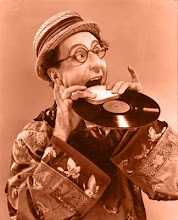
Funny Faces on the Films - Part Two
 by Geoff Collins
As Ted Healy often remarks during the course of Beer and Pretzels, here I go with another load. Not a load of old rubbish, though. Far from it: for this is part 2 of Funny Faces on the Films (or, if you like, Comic Countenances on the Kinema; I'll have a job topping that one), that wonderful four-page photo section within my beloved Film Fun Annual 1939. Legends mingle with obscurities; but if I recall correctly, I promised you that for our second episode, four out of the five comedians would be Third Bananas - and I'll stand by that statement. The first two are comedy legends; but hardly anyone's heard of Will Hay in the States; and W. C. Fields isn't that well-remembered in Britain. How's that? Did I get away with it?
Will Hay. Our readers in the UK will be smiling now as they think of Will Hay, the only comedian to make British music-hall comedy work well on the screen in Britain. (Chaplin and Laurel, let's not forget, made their films in Hollywood) Will Hay? Our American readers will be saying "Who???" so let me explain. Will Hay dominated British film comedy in the late 'thirties. It's a curiously British trait to recognise, accept and tolerate managerial inefficiency and petty bureaucracy. We've been "led by donkeys" for centuries; our most effective weapon is mockery. We've all known a Will Hay, a prosaic buffoon who's attained a position of minor authority through deviousness and trickery. In his movies, Will's wily enough to get the job but ultimately he's just too incompetent to do it properly. Unlike Robb Wilton's bumbling, good-natured variation on the same character, shifty-eyed Will is fully aware that he's useless and has to use all his cunning to disguise the fact. Consequently his employees, usually disrespectful fat boy Graham Moffatt ("Albert") and senile, crafty octogenarian Moore Marriott ("Harbottle") have this power over him. They spend much of the films' running time arguing and bickering, as they weave convoluted solutions to essentially minor problems. Oh, Mr. Porter! is the accepted masterpiece, but in my opinion Ask a Policeman is funnier as it gets to the main course straight away; it's my favourite comedy of all time.
The Full Monty, I seem to recall, was advertised as "the funniest British comedy since Four Weddings and a Funeral". So what? It was the only British comedy since Four Weddings and a Funeral. Now if they'd called it the funniest British comedy since Ask a Policeman.... that would be something.
After Will Hay, another scoundrel who devotes much energy to covering his tracks: W. C. Fields. Bill essentially played two characters: the desperately-henpecked husband with a monstrous family, who fights back in his own small way by muttering vaguely blasphemous asides, until the worm finally turns and he regains his self-respect (It's a Gift, You're Telling Me, The Bank Dick); and the much more extrovert pompous windbag, down on his luck in some seedy backwater of showbiz, always just one step ahead of his creditors (Poppy, The Old-Fashioned Way, You Can't Cheat an Honest Man).
Fully aware of posterity and the chance to make an easy "authorship" $50,000, Bill rarely missed an opportunity to include fragments of his stage sketches in his movies; so one is always aware of a discreet sense of familiarity and repetition. He also used his films to express revenge over long-harbored grudges. Supporting characters are often based on, or named after, real people who'd pissed him off in the past, including his own estranged son Claude who's usually represented - by such as Grady Sutton - as an unpleasant, blubbery, indolent wimp.
Some of Bill's sketches, and his blustery "sporting gent" characterization, bear a strong resmblance to the work of the British music-hall comedian Harry Tate; and there's a reason for this, which we'll discuss at a later date. In the meantime, all you Fields admirers are strongly advised to have a look at Tate's sketches on [yes, he's going to mention it!] www.britishpathe.com.
Bill Fields a Third Banana? Hardly; but in Great Britain you'd have to struggle to find any of his work on DVD; and that's not fair.
Leslie Henson. When I bought my Film Fun Annual 1939 at the age of seven (in 1963, not 1939, I hasten to add!) this photo of Leslie Henson jumped out of the page at me. The jumping analogy is apt: he looks like a frog! Many years passed before I located one of Leslie's records - Tell the Doc, from the stage version of Funny Face - and, wonder of wonders, he sounds like a frog as well. The total effect is astonishing. I've covered Leslie (in glory, I hope) in a previous article. His personality is so strong, even in photographs, that I've managed to accumulate a large collection of Hensonalia simply because he's instantly recognisable. You wade through a mass of bland, nondescript faces in old 1930s magazines, and POW! there he is again. It seems incredible that after World War Two he was considered so unamusing that the West End managers were reluctant to employ him, but that's what happened.
Stanley Holloway, his best pal, describes Leslie's decline very movingly in "Wiv a Little Bit O'Luck"; but we won't dwell on that. Let's just remember that in the 1930s, on the London stage, Leslie Henson was the Top Man. The Pathe website [oh, there he goes again!] has some fine examples, both silent and croaky, of his incredible range; and for your entertainment, here's my most recently discovered piece of Hensonalia.

click on the thumbnail yada yada...
Lupino Lane. Now we're talking. It always struck me as odd that these Film Fun Annual photos included two Lupinos, one of whom used Lupino as his first name. We'll get to Stanley Lupino in a later article, but for the time being....
Lupino Lane was born Henry George Lupino, and he was a member of the celebrated Lupino family of clowns, acrobats and dancers. He was distantly related to Stanley Lupino, whom we'll meet later; to untangle the genealogy would result in a long monologue along the lines of He's His Own Grandpa. To avoid this, we'll just show you the Lupino Family Tree (from Who's Who in the Theatre, 1946). It'll save a lot of time:

click etc...
It also seems odd that Lupino Lane has never received the acclaim he deserves. His career covered just about every aspect of showbusiness, and he excelled in all of it. In brief: he started in British music-hall as an acrobatic "boy comedian". He took the surname Lane as a tribute to his beloved maternal grandmother Sara Lane, and turned his real surname into a Christian name in order to retain his proud association with the Lupino dynasty; hence "Lupino Lane". His son, an equally gifted comedian briefly glimpsed in a decorating routine in A King in New York, and as the laughing fat man hit with a pie in Carry On Loving, was Lauri Lupino Lane.
"Lupino Lane" is a bit of a mouthful; mo stly he was known as Nipper or Nip. He made a large number of American silent comedies in which his acrobatic skills are the equal of Keaton's. All that's lacking, and this is the thing, sadly, that matters most in terms of immortality, is a consistent comic characterization. During most of the 1930s he was a star of London stage musical comedies, notably Me and My Girl, which is still revived today. In this he finally found a comedy persona that worked for him: the little cockney Bill Snibson who inherits a Dukedom. This show also gave him the hit song The Lambeth Walk, and it took over his life. He did over a thousand performances, made the film version (The Lambeth Walk; it was long thought to be lost but apparently there's an extant print with French subtitles. It's an important movie; why isn't it being shown anywhere?) and he even took the Snibson character into other, similar shows such as Meet Me Victoria. The programme's cover art is a fine example of "a picture paints a thousand words"; here you have Nipper Lane exactly.
It'll take a longer article than this to do justice to Nipper. While you're waiting for myself or Aaron to get around to writing it, you may enjoy his talents on www.britishpathe.com. Pathe caught him several times, and often at his very best, including a couple of live performances. You haven't heard the last of Nipper.
Ned Sparks. Ned Sparks???? Oops. I seem to remember that I said I wouldn't reveal which of our five subjects wasn't a Third Banana; so in order to keep my promise, let's take a look at that versatile King of Comedy, mega-talented Ned Sparks.
All right, the jig is up. I lied to you. Canadian-born Sparks growled his mainly unfunny lines in a flat monotone, had glazed staring eyes and looked like a Keaton crossed with a zombie. He wasn't a comedian at all. He was a character actor with only one character, and although he starred in some late-silent Educational comedies, he was most often seen as a hard-boiled, pessimistic theatrical agent or stage manager - as in Forty-Second Street. Ned's inclusion amongst all these star comedians is probably due to his rare leading role in a 1936 British production, Two's Company. For a brief moment, in Britain at least, he was among the top names; and then it was back to the "stage managers".
"Radio's Fred Allen" - a Ned lookalike and soundalike if ever there was one - made his feature film debut in a "Sparks part" in Thanks a Million, and did so with such wit, sparkle and immaculate comic timing that he turned a routine Dick Powell musical into a delightful experience. That's the difference.
Well, that's about it, readers. In part three we'll meet only two Third Bananas.
Don't go 'way now!
Will Hay. Our readers in the UK will be smiling now as they think of Will Hay, the only comedian to make British music-hall comedy work well on the screen in Britain. (Chaplin and Laurel, let's not forget, made their films in Hollywood) Will Hay? Our American readers will be saying "Who???" so let me explain. Will Hay dominated British film comedy in the late 'thirties. It's a curiously British trait to recognise, accept and tolerate managerial inefficiency and petty bureaucracy. We've been "led by donkeys" for centuries; our most effective weapon is mockery. We've all known a Will Hay, a prosaic buffoon who's attained a position of minor authority through deviousness and trickery. In his movies, Will's wily enough to get the job but ultimately he's just too incompetent to do it properly. Unlike Robb Wilton's bumbling, good-natured variation on the same character, shifty-eyed Will is fully aware that he's useless and has to use all his cunning to disguise the fact. Consequently his employees, usually disrespectful fat boy Graham Moffatt ("Albert") and senile, crafty octogenarian Moore Marriott ("Harbottle") have this power over him. They spend much of the films' running time arguing and bickering, as they weave convoluted solutions to essentially minor problems. Oh, Mr. Porter! is the accepted masterpiece, but in my opinion Ask a Policeman is funnier as it gets to the main course straight away; it's my favourite comedy of all time.
The Full Monty, I seem to recall, was advertised as "the funniest British comedy since Four Weddings and a Funeral". So what? It was the only British comedy since Four Weddings and a Funeral. Now if they'd called it the funniest British comedy since Ask a Policeman.... that would be something.
After Will Hay, another scoundrel who devotes much energy to covering his tracks: W. C. Fields. Bill essentially played two characters: the desperately-henpecked husband with a monstrous family, who fights back in his own small way by muttering vaguely blasphemous asides, until the worm finally turns and he regains his self-respect (It's a Gift, You're Telling Me, The Bank Dick); and the much more extrovert pompous windbag, down on his luck in some seedy backwater of showbiz, always just one step ahead of his creditors (Poppy, The Old-Fashioned Way, You Can't Cheat an Honest Man).
Fully aware of posterity and the chance to make an easy "authorship" $50,000, Bill rarely missed an opportunity to include fragments of his stage sketches in his movies; so one is always aware of a discreet sense of familiarity and repetition. He also used his films to express revenge over long-harbored grudges. Supporting characters are often based on, or named after, real people who'd pissed him off in the past, including his own estranged son Claude who's usually represented - by such as Grady Sutton - as an unpleasant, blubbery, indolent wimp.
Some of Bill's sketches, and his blustery "sporting gent" characterization, bear a strong resmblance to the work of the British music-hall comedian Harry Tate; and there's a reason for this, which we'll discuss at a later date. In the meantime, all you Fields admirers are strongly advised to have a look at Tate's sketches on [yes, he's going to mention it!] www.britishpathe.com.
Bill Fields a Third Banana? Hardly; but in Great Britain you'd have to struggle to find any of his work on DVD; and that's not fair.
Leslie Henson. When I bought my Film Fun Annual 1939 at the age of seven (in 1963, not 1939, I hasten to add!) this photo of Leslie Henson jumped out of the page at me. The jumping analogy is apt: he looks like a frog! Many years passed before I located one of Leslie's records - Tell the Doc, from the stage version of Funny Face - and, wonder of wonders, he sounds like a frog as well. The total effect is astonishing. I've covered Leslie (in glory, I hope) in a previous article. His personality is so strong, even in photographs, that I've managed to accumulate a large collection of Hensonalia simply because he's instantly recognisable. You wade through a mass of bland, nondescript faces in old 1930s magazines, and POW! there he is again. It seems incredible that after World War Two he was considered so unamusing that the West End managers were reluctant to employ him, but that's what happened.
Stanley Holloway, his best pal, describes Leslie's decline very movingly in "Wiv a Little Bit O'Luck"; but we won't dwell on that. Let's just remember that in the 1930s, on the London stage, Leslie Henson was the Top Man. The Pathe website [oh, there he goes again!] has some fine examples, both silent and croaky, of his incredible range; and for your entertainment, here's my most recently discovered piece of Hensonalia.

click on the thumbnail yada yada...
Lupino Lane. Now we're talking. It always struck me as odd that these Film Fun Annual photos included two Lupinos, one of whom used Lupino as his first name. We'll get to Stanley Lupino in a later article, but for the time being....
Lupino Lane was born Henry George Lupino, and he was a member of the celebrated Lupino family of clowns, acrobats and dancers. He was distantly related to Stanley Lupino, whom we'll meet later; to untangle the genealogy would result in a long monologue along the lines of He's His Own Grandpa. To avoid this, we'll just show you the Lupino Family Tree (from Who's Who in the Theatre, 1946). It'll save a lot of time:

click etc...
It also seems odd that Lupino Lane has never received the acclaim he deserves. His career covered just about every aspect of showbusiness, and he excelled in all of it. In brief: he started in British music-hall as an acrobatic "boy comedian". He took the surname Lane as a tribute to his beloved maternal grandmother Sara Lane, and turned his real surname into a Christian name in order to retain his proud association with the Lupino dynasty; hence "Lupino Lane". His son, an equally gifted comedian briefly glimpsed in a decorating routine in A King in New York, and as the laughing fat man hit with a pie in Carry On Loving, was Lauri Lupino Lane.
"Lupino Lane" is a bit of a mouthful; mo
stly he was known as Nipper or Nip. He made a large number of American silent comedies in which his acrobatic skills are the equal of Keaton's. All that's lacking, and this is the thing, sadly, that matters most in terms of immortality, is a consistent comic characterization. During most of the 1930s he was a star of London stage musical comedies, notably Me and My Girl, which is still revived today. In this he finally found a comedy persona that worked for him: the little cockney Bill Snibson who inherits a Dukedom. This show also gave him the hit song The Lambeth Walk, and it took over his life. He did over a thousand performances, made the film version (The Lambeth Walk; it was long thought to be lost but apparently there's an extant print with French subtitles. It's an important movie; why isn't it being shown anywhere?) and he even took the Snibson character into other, similar shows such as Meet Me Victoria. The programme's cover art is a fine example of "a picture paints a thousand words"; here you have Nipper Lane exactly.It'll take a longer article than this to do justice to Nipper. While you're waiting for myself or Aaron to get around to writing it, you may enjoy his talents on www.britishpathe.com. Pathe caught him several times, and often at his very best, including a couple of live performances. You haven't heard the last of Nipper.
Ned Sparks. Ned Sparks???? Oops. I seem to remember that I said I wouldn't reveal which of our five subjects wasn't a Third Banana; so in order to keep my promise, let's take a look at that versatile King of Comedy, mega-talented Ned Sparks.
All right, the jig is up. I lied to you. Canadian-born Sparks growled his mainly unfunny lines in a flat monotone, had glazed staring eyes and looked like a Keaton crossed with a zombie. He wasn't a comedian at all. He was a character actor with only one character, and although he starred in some late-silent Educational comedies, he was most often seen as a hard-boiled, pessimistic theatrical agent or stage manager - as in Forty-Second Street. Ned's inclusion amongst all these star comedians is probably due to his rare leading role in a 1936 British production, Two's Company. For a brief moment, in Britain at least, he was among the top names; and then it was back to the "stage managers".
"Radio's Fred Allen" - a Ned lookalike and soundalike if ever there was one - made his feature film debut in a "Sparks part" in Thanks a Million, and did so with such wit, sparkle and immaculate comic timing that he turned a routine Dick Powell musical into a delightful experience. That's the difference.
Well, that's about it, readers. In part three we'll meet only two Third Bananas.
Don't go 'way now!
Labels: cinema, Film Fun, Fred Allen, Leslie Henson, Lupino Lane, Moffatt and Marriott, Ned Sparks, OTR, W. C. Fields, Will Hay
posted by Aaron Neathery at 11:39 AM
3 comments