Monday, May 28, 2007

Super Service!

Having not yet seen all of their pictures, I really don't know if the Ritz Brothers ever had a better showcase than Hotel Anchovy, their 1934 screen debut for Educational. Certainly, this must be the highest ever concentration of pure Ritz in a film; exhausting, bizarre, and very funny... much funnier than the three Fox pictures I've seen (although some say that their Universal pictures are much worse). Harry, as would forever be the case, gets the lion's share of footage as the act's front-man, and he deserves the attention. Watching Harry's anything-goes performance, it's little wonder why Mel Brooks holds such a high opinion of him. The Ritzes returned in 1936 in a running-gag role in Sing, Baby, Sing for Fox. In the film's most memorable moment, Ted Healy, on loan from MGM for the first time without his stooges, gives Harry, Al, and Jimmy a nostalgic triple-slap.


Part 1

Part 2

Labels: , ,

Tuesday, May 22, 2007

Let That Be a Lesson To You: Ted Healy in Hollywood Hotel

Ted Healy blew the bulk of his film career at a studio with no feel for comedy, finally found his niche on a loan-out, and then was killed less than a month before his greatest screen appearance had reached the public. It's not as though MGM didn't have its perks. Although he was generally handled as a utility comic, from the beginning the studio was willing to cast Healy in dramatic and semi-dramatic roles that helped boost his stock as a flexible character actor (and kept him extremely busy). Although Ted's dramatics are quite good in Stage Mother (1933) and Death On the Diamond (1934), his real strength was comedy, and MGM rarely delivered on that front. Warners, on the other hand, certainly did, and Ted's rough, streetwise persona was a neat fit for the Warners house style. So in 1937, Ted found himself at Warner Brothers, teamed with Dick Powell for a pair of major musical comedies; Varsity Show, directed by William Keighley, and Hollywood Hotel, directed by Busby Berkeley. It's a whole new world for Ted, and you can tell from the renewed gusto in his performances that he knew it. Warners was also clearly happy to have Ted on board. He's second-billed in Varsity Show, and while he's fourth-billed in Hollywood Hotel, he has even more screentime; so much, in fact, that the film is essentially a Powell/Lane/Healy vehicle. Varsity Show is terrific (and better than anything he appeared in at MGM) but Hollywood Hotel is far and away Ted's finest hour. He sings, he clowns, he shares the film's centerpiece musical number, "Let That Be A Lesson to You", with Dick Powell and Rosemary Lane, and Ted even "gets the girl" at the end (in this case the wonderfully weird Mabel Todd). Contrary to what you may have heard, by 1937, Ted was far from washed-up and adrift. He was a genuine box office draw appearing in huge roles in major musicals for one of Hollywood's Big Three. Any reassessment of his career should begin exactly here.

Ted meets Louella Parsons (no, she can't act worth a damn) in an elevator. SLAP! "Hey, Parsons!"


"... I like you on account-a ya got such a nice swollen face!" Ted's first scene with Mabel Todd, a stooge with a difference. In a just world, Todd and Healy would have made a dozen films together. Ted's throwaway lines and comebacks are priceless.


My favorite musical number of all time! Drive-ins!! Benny Goodman!!! Hamburgers! Poodles doing tricks!! Johnnie 'Scat' Davis!!! Richard Whiting and Johnny Mercer!! TED HEALY TORMENTING EDGAR KENNEDY!!!!! Powell and Healy imitating the Kennedy slow-burn!!!! MGM could never have made a number like this.


It would be a sin not to include the scene that follows. Ted so often played semi-straightman to other comics that it's incredible to see none other than Edgar Kennedy do the same for him! A whole new world, indeed!

Labels: , , , , , ,

Friday, May 18, 2007

Wise Guys Prefer Brunettes

As promised yesterday, here is video number two, Wise Guys Prefer Brunettes (1926). This is another one of those curious little classic comedy crossroads that crop up every now and then when the planets align. Try this on for size: Ted Healy, king of stooges, directed by Stan Laurel. Back when I maintained tedhealy.com, I came across Ted and Betty Healy's entry in a 1926 actors yearbook that promotes them as Hal Roach comedy stars. Presumably, Ted and Betty were snapped up by Roach while performing on the West Coast for roles in his All-Star series but, for whatever reasons, this lone comedy, sans Betty (or is she hidden among the co-eds?), resulted before the couple headed back out onto the vaudeville trail. Does anyone know what really happened here? Ted's bumptious and rather surreal personality comes across better than would be expected, especially in his introductory scenes where Laurel allows Ted plenty of latitude to ad-lib (H. M. Walker's titles even read as though he had been paying close attention to Ted's speech patterns), but it's hard to see exactly where he could have gone in silents. Despite second billing beneath Helene Chadwick, the real star of Wise Guys Prefer Brunettes is Jimmy Finlayson, playing his role as college dean to the hilt and beyond. A dramatic actress with a pretty impressive filmography stretching back to 1916, Helene Chadwick typifies the down-on-their-luck, recently-faded stars that Roach populated his All-Star comedies with in that she's simply not very good at comedy. Helene was three years divorced from director and WWI flying ace William Wellman who would go on to win an Oscar in 1937 for A Star is Born, in which Chadwick appears as an extra. It was her last film appearance. She died in 1940 from complications arising from a fall over a chair.


Part one

Part two

Labels: , , , ,

Thursday, December 21, 2006

Ted Healy: In Memoriam

In his own time, Ted Healy's biggest problem was Ted Healy. Ted was an out of control actor before it became fashionable. Highly talented and blessed with the ability to woo a tough crowd in record time, Ted also drank to excess, gambled, womanized, fought, and was even a bit of a pyromaniac, reportedly carrying a hip flask full of kerosene. He was a true eccentric, given to whims and not at all afraid to make a scene in public if the mood struck him. He could be generous and fiercely loyal to his friends, but his hair-trigger temper repeatedly landed him in hot water and, in several instances, undoubtedly set back his career. 69 years ago today, the risks of living dangerously caught up with him and he died of liver failure following a drunken brawl at the Brown Derby. He was only 41.

Today the problem with Ted Healy is his stooges. If they had never split for the cozy, atavistic comforts of Columbia, if they had never become baby boomer pop culture icons, if they had remained the rough-and-tumble goons of their vaudeville days with Ted, then Ted himself would probably be much better regarded today, probably as exactly what he was; a top-notch, talented and extremely innovative comedian who died the very peak of his abilities. But that isn't the way it worked out. If Ted Healy is remembered at all, it's never just Ted that most people remember, it's Ted Healy and his stooges.. or Stooges, rather. His best work in film, his two pictures for Warner Brothers, remain sadly obscure, especially in contrast with the 190 bite-size and comfortably similar Stooge shorts that have been TV mainstays since 1958. Ted's only starring feature, Soup To Nuts, remained largely unseen until 2005 when it was released on DVD with a sleeve featuring a huge picture of the Stooges. Them's the breaks.

Don't get me wrong.. I love the Stooges. I grew up with the Stooges. But the unbridled hate so many die-hard Stoogephiles feel towards Healy, witnessed in full during my time as webmaster of tedhealy.com, saddens me. There's certainly no poetic justice in Ted's fate unless you accept the fairy tale notion that the Howard, Fine, and Howard spent their formative years toiling anonymously, propping up an ungrateful, talentless ham. This handy and highly marketable myth aside, the real problem is that the dynamic between Ted Healy and his stooges is innately divisive. The comedy emerges from that division. There is no real common ground to be found between Healy's eccentric and off-handed cynicism and the Stooges' classic clowning, nor should there be. That's why Moe, even as "leader" of the Stooges, is still a stooge (whether he knows it or not), whereas Ted, when his role as leader is literalised in films such as Meet the Baron, is simply a world apart, a tinpot tyrant, and there's no doubt whatsoever that he is in charge. When an audience accepts the complete package, as they did in the 20s and 30s, that innate divide between the cynical proxy and the clown (or clowns) is gold. But when an audience favors one side over the other, it's poison. To someone weened on the Columbia shorts and incapable of seeing beyond them or contextualizing them, Ted must come across as the worst kind of interloper and, as such, is apparently worthy of the kind of scorn usually reserved for serial killers and politicians. A pity.

The cynic and the clown; if Ted Healy didn't invent the formula, he certainly popularized it. Milton Berle brought it lock, stock, and barrel into the television age, with Arnold Stang regularly playing stooge and Berle playing the wiseass go-between. Martin and Lewis became the hottest nightclub comedy act in history with it before Paramount pissed it all away by repeatedly casting Dean as some kind of humorless villain. Even today, you can see a down-to-earth equivalent of the dynamic between David Letterman and many of his guests. At least Letterman can move on to the next guest. Ted is currently locked in limbo with his Stooges, his post-stooge film work remaining largely unseen or ignored. Unfortunately, it's in that work where Ted Healy really is, the gruff, scene-stealing character actor who could handle both comedy and drama with flair. By 1937, he and his writers at Warners had even discovered ways to make you care for the guy (think W. C. Fields). Everything pointed towards a brilliant future for Ted. Given the trajectory that American showbusiness actually followed, Ted Healy would have been ahead of the curve every step of the way, from the sharp cynicism of wartime comedy to the dawn of "vaudeo" where Ted's quick wit and ability to work an audience would have certainly given Uncle Miltie a run for his money. As far as I'm concerned, Ted Healy will remain the greatest "what if" of classic comedy, and I'll be drinking a 60-proof toast to his memory this Christmas.

Reader EastSide has been kind enough to draw my attention to these vintage Healy clips from YouTube. First, 6 minutes and 8 seconds from Plane Nuts (1933), the second most complete record of Ted's vaudeville act (the first, and superior, being the recreation of the act in Soup To Nuts (1930)).


Here's a nice clip of Ted hitting on a couple of unbilled Chinese women in a clip from Myrt and Marge (1933). They're singers, but I have yet to discover their names. Myrt and Marge is easily the finest hour for Ted Healy and his stooges as supporting castmembers in a feature. MGM never handled the team nearly as well as Al Boasberg and Universal. Ted's rueful glare at the camera at the film's close is one of my all-time favorite Healy moments. Brilliant.


Labels: , , , , , , ,

Friday, September 29, 2006

Stooge Friday!!!

First, a bit of horn-blowing: this month's Three Stooges Journal features my article on Healy "stoogette" Marion "Bonnie" Bonnell accompanied by a couple of photos of Ted and Bonnie that I don't recall ever having seen before. Used to seeing my work online where page-count is an abstraction, I was shocked to discover how long the Bonnell article really is on paper. Very strange. This issue of TSJ also contains an insightful article by Bobby Winslow entitled Lady Godiva, Eh?: Curly and Gendered Laughter that covers some of the same ground as the previously mentioned Boxwell piece about Wheeler and Woolsey, but is written by someone who has an appreciation for the material and understands context. TSJ's narrow focus demonstrates that, no matter how well-known the subjects may be, there is a near inexhaustible wealth of information yet to be revealed about classic comedy. And I must admit that I'm very predisposed towards any magazine that devotes its cover to a big photo of Vernon Dent (and publishes my work). At $9 a year, it's a steal. Contact editor Gary Lassin at garystooge@aol.com for more info.

And the classic comedy vinyl just keeps on coming. Courtesy of Way Out Junk comes 1959's The Three Stooges: Madcap Musical Nonsense at Your House. Riding the crest of their big TV comeback, the Stooges released a number of kiddie albums, and this is a pretty decent one. The first (seemingly improvised) track, "We're Coming to Your House", interestingly turns the notion that adults don't like the Stooges into a selling point for their act:
All: Though Mommy won't like us
and neither will Dad,
We're coming to your house..
Larry: To break up the joint!
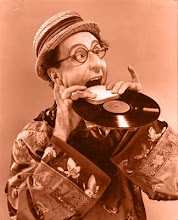
I don't think I've seen the generation gap angle used elsewhere in regards to the Three Stooges, but it has long since become the cynical standard practice for advertising to kids. This track gave me the false hope that they'd follow it with a dramatized skit in which the Stooges visit one of their youthful fans and devastate his/her house in an hilarious orgy of whimsical violence. Track six, the final track on side A, ends with a nice bit of conceptual humor as the Stooges cope with the problems inherent in being "in" a record being played. Curly Joe ends up trapped in a groove and tells the kids that they can release him by flipping the record over. Larry closes out the bit with a nice bit of deadpan delivery.
Larry: Careful! That's it.. Don't hurt him with the needle...

Labels: , , , , ,

Saturday, May 20, 2006

The Mystery of Bonnie Bonnell

Just recently, Geoff asked me for my opinion of Bonnie Bonnell: "Was she the least talented woman of all time, or is there some sly in-joke going on?"

If I had been asked this a few years ago, I probably would have leaned towards the former. Bonnie Bonnell, as any fool could plainly see ("Ah kin plainly see that!"), was Ted Healy's talentless showgirl inamorata, a secondary component of his stage act that had found herself out of her depths once the act had gone Hollywood. How else to explain her flailing dance number in Beer and Pretzels or her stilted non-performance in Nertsery Rhymes? But now, having given the matter some thought, I just don't know..

Following Soup To Nuts for Fox in 1930, Ted's stooge act had split and then reformed, with Curly Howard replacing both his older brother Shemp and fourth stooge "Pansy" Sanborn. There was yet another new addition to the act; Marion Wright "Bonny" Bonnell, Ted's first and only lady stooge. In 1932, a Hollywood nightclub appearance had led to a one-year contract with MGM, the most prestigious studio in town, and one with a tin ear when it came to comedy. Ted and co. were quickly put to work in shorts (40% new material, 60% unused MGM musical and specialty numbers) and, separately, all over the studio. Strike that.. Separately, except for Bonnie, who was relegated solely to the Healy shorts. At first glance, the reasons would appear obvious. Nertsery Rhymes presents Bonnie as MGM "eye candy", trying her damnedest to shimmy, shake, and belt out tunes as a bizarre "fairy godmother". She also plays straightwoman to Ted's stooges, delivering feed lines in a dull, lifeless monotone. Poor Bonnie is absolutely dreadful on all counts and even seems vaguely resentful. She fares little better in her next film, Beer and Pretzels, in which she receives a showy song and dance number that is so strange and inept that one has to wonder what contemporary audiences were supposed to make of it.

The third MGM Ted Healy short, Hello Pop!, is sadly missing, but the fourth, Plane Nuts, provides us with an extremely rare look at Healy's stage act.. or, at least, the final incarnation of it. Moe Howard introduces Ted, "Ladies and gentlemen. Ted Heel... Phew!", and receives the first of many, many slaps. Shortly after, as Ted sings, Bonnie dashes out onto the stage to cram a load of flowers into Ted's outstretched hand. Later, she rejoins Ted and the stooges during their standard patter routine ("What's your name?" "George Washington." "You picked out a good name. You the fella who chopped down the cherry tree?" "Naw.. I ain't worked in a year and a half!"). Bonnie's costume marks her as an eccentric, but her delivery still sounds somewhat restrained. Nevertheless, she plays her part as a genuine stooge, even going into a conspiratorial huddle with Moe, Larry, and Curly during the strange "Take a number from one to ten" routine.

The fifth, and final, Healy MGM short is something of a revelation. In The Big Idea, Ted stars as the owner and sole employee of The Big Idea Scenario Company, whose attempts at scenario writing are forever interrupted by a steady stream of intruders wandering through his office. The principal intruder is Bonnie, whose innate eccentricity has finally broken through. No longer the bland showgirl of the earlier shorts, she appears now as seemingly deranged cleaning woman, dumping basket after basket of trash into Ted's office. Ted is irate. "There's one thing I'd like to ask you. Why do you throw all of the garbage into my office every night?" Bonnie responds by laughing defiantly and poking Ted in the chest. "I knew.. I knew you were gonna ask me that question!" she says before wandering off to another corner of the office. Ted is not satisfied with her response. "Say! Why don't you answer me?" Suddenly, Bonnie seems more receptive. "Oh.. The reason is.. I like to clean the whole building into one room." she replies, illustrating her point with oddly elaborate hand gestures. "It makes it so much easier to clean up the rubbish!" Ted decides to pitch his story idea to Bonnie, who listens attentively with an intense, almost Harpo-esqe, look on her face. She even suggests a story idea of her own to Ted, growing increasingly, and inexplicably, angry as she outlines it:

"Why don't you write a story about a gentleman who makes love to a lady and they go for a walk in the woods and the lady finds out he's NO GENTLEMAN!!!"

At the end, Ted's girlfriend, Muriel Evans, catches Ted and Bonnie in an embrace and beans him over the head with a hammer. Unlike their previous shorts, The Big Idea presents Ted and Bonnie as a double act, with Howard, Fine, and Howard appearing as little more than a running gag (a brilliant one, though) with a few lines at the end. What had happened behind the scenes to bring this about? Was it perhaps a change of director? Jack Cummings had been the team's regular up to this point. The Big Idea was helmed by an uncredited William Beaudine. Whatever had happened, Bonnie has here become the precursor of Mabel Todd, Ted's loony love interest in Hollywood Hotel. It just seems more appropriate for his seedy, tough-talking screen character to hook up with deranged women ("I like you! You have such a nice swollen face!" says Mabel, complimenting Ted in HH) than, say, Muriel Evans.

I have a confession to make. I've skipped a film here. In 1933, between Plane Nuts and The Big Idea, MGM loaned Ted and co. to Universal where they appeared in Myrt and Marge, a backstage story based on a popular radio soap opera. I have yet to see this movie! Bonnie reportedly has a running gag as a gatecrasher. Can anyone here tell me how Bonnie plays her role? Is this the Bizarro Bonnie of The Big Idea or the Bland Bonnie of Beer and Pretzels? If the former.. well, I don't know what that means. If the latter.. I don't know what that means, either.

Bonnie's final screen appearance is in Paramount's Hollywood On Parade, episode B-9, one of those creaky (and sometimes creepy) newsreel-type shorts that show Hollywood stars at work and play.. or, in this instance, stumbling around a Paramount set that's supposed to look like a speakeasy. Silent comedian Ben Turpin is on hand in an awkward performance that reveals exactly why his career had ended with the coming of sound (before, actually). Major comedy acts of 1934 such as Ed Wynn, Jimmy Durante, and Wheeler and Woolsey make lackluster appearances as well, but the limelight belongs instead to Ted, Bonnie, and the stooges. "Please.. I beg your pardon.." says Bonnie, attracting Ted's attention by jabbing him in the shoulders. "Is your name Ted Heel?" Ted turns around and looks straight through her. "No, Ted Healy the name is, not "Heel"." "Listen.." she says. "Did you originate stogies?" "What?" "Are you the first person who ever had stogies?"

Oh.. stooges! Does Bonnie represent a deranged fan? Maybe one of those people who stopped Ted in public to ask him bizarre questions? It's likely that Ted was often asked whether or not he was the first comic to use stooges, and he probably would have replied in the affirmative. Whether he was or not, he certainly took the concept further than anyone else in the business. It's more than likely that Ted was the first comic to use a female stooge.

Ted has no time to bother with Bonnie's question. Instead, he turns to Larry Fine and says, out of nowhere, "I want you to be a nice boy. When you're a nice boy, your fairy godmother always watches over you." "Your what?" asks Larry. "Your fairy godmother always watches over you!" Bizarrely, Ted turns to Bonnie in anticipation of the punchline:

"I have an uncle I'm not sure of..."

Ted can't slap a woman, so Larry gets it in the kisser. "None of that now." Back to Bonnie. "But I wanna know.." she warbles like a brain-damaged Zasu Pitts. "You know, I know a system.. But I know how you make people laugh!" "You do, huh?" "Yes.. I certainly..." she trails off. "How?" demands Ted. Bonnie slaps Ted awkwardly and walks away. Ted is unfazed. "You're wrong, lady!" The stooges attempt to demonstrate the true Healy laugh-grabbing method by slapping each another, but to no avail. Healy has no alternative but to demonstrate himself. "This is the way, isn't it?" Ted unleashes his devastating gattling gun triple-slap, getting each of his stooges squarely in the face with a single sweep of his arm.

In this brief clip, as in The Big Idea, Bonnie Bonnell displays a peculiar sense of comedy that works well within the framework of Healy's highly peculiar act. You may not find her funny here (I do) but she's certainly anything but a cypher. Let's keep in mind, also, that she was no novice, having been appearing on Broadway since at least 1925. In 1926, Bonnie was in the ensemble of Clark and McCullough's biggest Broadway hit, The Ramblers, and was apparently discovered by that show's director, Phillip Goodman, for she next appeared in Goodman's Five O' Clock Girl as "Molly the Maid". There then followed an association with Ted Healy's good friend producer/director Billy Rose, first in a 1930-31 revue entitled Sweet and Low, and finally, later that year, in Billy Rose's Crazy Quilt with Ted and his replacement stooges, Garner, Wolf, and Hakins. According to Bill Cappello, Mousie Garner recalled Bonnie as "a very good dancer", but little else. While Ted and Bonnie definitely did strike up a relationship, her role in Ted's act was anything but payback for services rendered. Not even Ted Healy was impulsive enough to sabotage his own act with a non-talent. But here's the mystery: what was Bonnie to Ted's act? Even with her performance in Plane Nuts as a record, she remains obscure. Ted and his stooges display an easy chemistry built up over years of joint vaudeville experience, but Bonnie's relationship with the team, even her very personality, shifts dramatically from one film to the next. Sometimes she's a comic eccentric, sometimes a vamp, sometimes a stooge.. In some shorts she appears to be a budding comic talent; in others, terminally incompetent. Was this the result of studio interference? Was her original role in Healy's act as a legitimate stooge vetoed by MGM execs who, feeling that audiences wouldn't accept her as an eccentric, attempted to recast her as something more traditional? Or was her nebulous characterization in films merely a reflection of her nebulous function in the act; a trial and error process intended to figure out exactly what to do with Bonnie in movies until her contract ran out?

Ultimately, the only performer under that unifying one-year contract that MGM knew what to do with was Ted Healy. Ted had range as an actor that the others lacked; by the time of his death in 1937, he appeared poised to emerge as a major comedy star.. for Warner Brothers. MGM was simply not a studio for comedy, and it's just as well that they let Howard, Fine, and Howard slip through their fingers because the stooges would have been left to rot on the vine. Instead, Columbia beckoned.

Which leaves Bonnie Bonnell.

Bonnie had not made enough of an impression during her year at MGM to count for anything once the contract expired. Her once promising career with Healy had turned into a dead end. Despite the dissolution of the act and a lack of offers to continue in film, Bonnie remained in LA. Her bills were probably paid by Ted for a time, but this wouldn't have lasted long. In 1935, Ted, an affirmed firebug who reportedly carried a flask of kerosene in his garter, landed in jail for breaking into her apartment and using her stove to set fire to some chairs and some of her clothes. She refused to press charges, claiming it had all been a "misunderstanding". Who knows? The following year, Bonnie married a auto parts salesman named Jack Hayes. She spent the rest of her life in LA, dying in 1964 of liver failure at the age of 58.

Labels: , , ,

Tuesday, January 17, 2006

Observations on Ted Healy

One of the nicest compliments I'd received for my now-dead Ted Healy page was that Ted, were he alive, would likely have slapped my back hard enough to sting, bought me a stiff drink, and then done something absolutely horrible and emotionally scarring to me. Ted Healy, Bobby Clark, and Paul McCullough are the three comedians who really sparked my interest in comedy obscureology. It's inexplicable that they all aren't better known, but Ted's relative obscurity is the most curious and disturbing of all to me. Clark and McCullough are an acquired taste, admittedly, and I'm speaking as one of their biggest boosters. Even their best films undoubtedly pale in relation to their stage work, and Bobby, especially, is a Broadway personality confined in a celluloid prison, a personality rather too bold and alien (not to mention alienating) for the intimacies of film. But Ted Healy was simply born to be a film star, and it was apparent even in his silent 1926 "tryout", Wise Guys Prefer Brunettes, for Hal Roach. He's real, engaging, fascinating, and frequently terrifying. The two-dimensional boundary of the screen vanishes for Ted, a comedian so direct and modern.. some would say postmodern.. that it's a shock to me that he isn't better regarded today, the effects of the smear campaign notwithstanding. You can see his influence on television even now, his legacy most apparent in comic MCs such as Conan O'Brien and Jay Leno. Healy was certainly one of the first to shatter the accepted role of the performer as Performer, destroying the barrier between comedian and audience. After all, what did he do? Bert Wheeler was a song and dance man, Eddie Cantor a wisecracking singer, W. C. Fields a juggler; what was Ted Healy? Ted's right to the limelight was assured simply because he was a funny man, not a man who expertly told funny jokes or funny stories. Ted Healy scarcely cared about jokes, had no patience for them. In Soup To Nuts, you can see for yourself his impatience with the "laff lines" and his eagerness not to dwell on them. The stooges were the joke-machines of the act, near parodies of slapshoe vaudeville comedians, and Ted was just as much their audience as the actual audience was. His reactions to their calculated inanity became the vicarious reaction of the crowd; their emotional release as well. The stooges.. Sanborn, Howard, Howard, Fine, Howard, Hakins, Wolf, Garner, etc.. were living props, and Ted made sure an audience understood that they deserved every last slap. As purveyors of the oldest and/or stalest and/or lamest jokes known to mankind, or for simply attempting to upstage the headliner, it was Ted's job.. his honor.. to stand up for the audience and slap the stooges silly. If Curly or Freddy comes skittering across the stage, mugging like a maniac, in the middle of Ted's song, he's asking for trouble; so why the hell not give it to him? That's what he's there for! No one is asking for sympathy. I can't imagine a single audience member in Ted's entire stage career standing up and saying "Hey, you big bully! Leave that little guy alone!" That Howard, Fine, and Howard are famous today for being, frankly, atavistic, albeit talented, clowns while Healy, an innovator, true eccentric, and probably genius, is a footnote in their careers says something too depressing about life for me to contemplate.

Labels: , , ,

Saturday, December 31, 2005

HAPPY NEW YEAR to all you lucky people!

From Nick, Geoff, myself, Ted Healy, and Ted's beloved outboard motor, we all wish you the very best of new years. Many and varied apologies about the quietness of this blog this past week, but, you know, Christmas and all... We'll all be back with more nice tasty comedy very soon, including a review of what is quite possibly the only Pat and Patachon DVD set in North America. CAN YOU STAND THE SUSPENSE????

Labels: ,

Saturday, November 05, 2005

Geoff Collins Reveals the Healy and Costello Story!

The abrupt departure of Ted Healy's stooges in early 1934 left the great comedian in something of a quandary. Of course, he should have seen this coming; he'd had to pay them the absolute minimum wage for some time, in order to afford the basic necessities of life: booze and women. And why was Moe so unsympathetic and inconsiderate about this? Not that Ted needed stooges, but it was nice to have someone to slap around when his demons took hold - which was usually three or four times a night.

THREE stooges cost a lot of money though.... The thought crossed Ted's mind: why not a double act? So he sent a wire to Lou Costello.

They'd met, briefly, before, in '26 or '27 at the Hal Roach studio. Ted, already a star, was doing a guest bit in Wise Guys Prefer Brunettes; Lou was an extra, doing his best to get noticed (he's visible, mugging away expansively, in the front row of the boxing auditorium audience in The Battle of the Century) But whereas Ted subsequently found fame and fortune in Hollywood and the New York nightclubs, Lou had gone back to vaudeville and burlesque. But he was a funny little guy and he could take a slap.

The team clicked immediately and they soon built up an impressive range of routines, most notably "Who's the Daddy Bear ?" in which would-be nightclubber Ted impatiently tries to get "baby son" Lou to sleep by telling him the story of Goldilocks. However, the three bears are called Who, What, and I Don't Know, resulting in a very exasperated Ted and a much-slapped Lou.

Another celebrated routine, "What time Is It?" cast Ted as the merciless drill sergeant and Lou as the hapless buck private unable - and secretly unwilling - to follow the simplest instruction. This featured Ted's catchphrase "You belong in the INSANE asylum" and the revelation (an idea later recycled on the English radio Goon Show) that although Lou carries an armful of watches, he has the time written on a piece of paper.

Successful vaudeville tours were soon followed by guest appearances in Columbia features and a few surreal musical shorts for MGM which were in effect thinly disguised showcases for the dubious talents of Ted's girlfriends (Bonnie's in the Money) A contract with Universal in 1940 resulted in the team's first starring feature, Hey Teddy!. This was a remake of the horror classic The Old Dark House, with Ted and Lou as stranded travellers forced to spend the night in a spooky mansion populated by a family of homicidal maniacs. The head of the household, Saul Femm, was played with great relish by imported comic Cyril Fletcher, whom the boys had befriended on a British music hall tour the year before. Cyril was magnificently creepy in the role, and this led to a succession of similar butler-manservant parts in cheap horror-comedies for Monogram, and one co-starring role at PRC with Harry Langdon: The Odd Odor. But despite a splendid turn as Renfield in Healy and Costello Meet Dracula, he realised his movie career was going nowhere and he returned to English variety and television, where he terrified a whole new generation of children.

By this time, though, the H & C comedies, churned out at the rate of two or three a year, were becoming formulaic and Ted's drinking was beginning to affect his timing, although there were occasional high spots such as the reworking of the drill sequence in Lou's Your Buddy. Ted was also bitter that Lou had managed to reverse the original pay structure so that he now got 40% and Lou got 60%. This led to the inevitable acrimonious split, and Lou teamed up with vaudeville veteran Sidney Fields, who'd been struggling along in another double act with Bobby Barber. In order to placate Bobby, Lou kept him on as a sort of paid fall guy. Sid and Lou went on to become popular TV stars and eventually landed their own weekly series in which they played down-on-their luck vaudevillians trying to keep one step ahead of the landlord, who was played by another old pal, gravelly-voiced Bud Abbott. [I'll bet you thought he'd never arrive!]

In the meantime Ted, after his young wife virtually forced him into a lengthy drying-out session at the Keeley Institute, also went on to become one of the early stars of TV, taking over as MC on the Texaco Star Theater at very short notice. It has recently been suggested that the vicious brawl outside a New York nightclub, which resulted in the hospitalisation of host Milton Berle and the death of guest star Wallace Beery, was not the result of a random attack by students, but was planned and carried out by mobsters. Did Lou help his former partner back into the limelight? One of the retreating assassins was heard to yell "I'm a ba-aa-aad boy!"

Ted's career went from strength to strength; he appeared many times on Sid and Lou's show as Mike the Cop, never failing to give Lou a slap at every opportunity. Eventually he settled in as popular host of The Tonight Show.

Lou died in 1959, and a few years later Ted showed that all the old grievances were long forgotten when he presented an affectionate TV-movie tribute: Hey Fieldsie! Ted himself celebrated his golden wedding anniversary in May 1986 and died two months later at the age of 89.

But what became of Ted's original stooges? Apart from a few guest bits on children's TV shows such as Uncle Mousie's Nertsery Time, they were never heard of again.

Labels: , , ,

Pendelton and Healy

I'm not quite sure how happy Ted Healy would've been with this billing, but it does sound better than Healy and Pendelton. Nat Pendelton, the big, beefy comic foil and sometimes heavy, and King of Stooges, Ted Healy were both under contract to the Cartier of studios, MGM at the same time. They appeared in 4 films together as a team, popping in and out of B unit murder mysteries (and one A unit feature, Reckless w/Harlow and William Powell), and relieving us with their high-larry-ass highjinx. If you watch the films, Lazy River, Here Comes The Band, Death on the Diamond, and Murder in the Fleet, you'll find this duo dishing out what seems to be semi-spontaneous bits of business as the leading man and woman actually solve the crimes. They were always cast as friendly rivals, sniping at each other as they usually opt for the same girl.

Now, I can't honestly say that I think they were any threat to Laurel and Hardy, or Wheeler and Woolsey, but they were both charismatic and very amusing performers, whether separately, or together. Upon seeing these films for the first time on the only station I can seem tolerate these days, TCM, I wondered if it was no ordinary coincidence that MGM put these two contract players together. They tried it with Keaton and Durante. They also tried it with Karl Dane and George Arthur (until sound put the Kibosh on that duo due to Dane's thick accent. He ended up selling hotdogs outside the studio gates, and then, not surprisingly, shooting himself to death surrounded by artifacts from his moribund career.). Healy had only recently split with his Stooges, and it would have made sense for the studio to try to figure the best way to use his talents. Pendelton must have seemed a good partner for the newly solo Healy. He could do the dumb act, and he could play and he was proficient with a wisecrack. Pendelton even inherited an interesting place in comedy team history, he actually gets killed in Death on the Diamond! Now, I know that other comedy teams do cartoon-y deaths. Oliver Hardy in Flying Deuces, for instance....or Lou Costello in The Time of Their Lives, but Pendelton wasn't coming back as a horse, or to comically haunt a house, he was dead. Dead like a doornail. Like culture in this country....DEAD! Cool.

So, there you have it. We're left with only questions to accompany the reels of film. What if Healy hadn't died (as opposed to Pendelton, who only died in a movie)? Would there have been a series of B films starring this mondo obscuro pair? Would Columbia have picked them up for a shorts series? Perhaps Universal would have used them as comedy relief in the Richard Arlen action films, or Warners could have made them up in the Frank McHugh and Allen Jenkins mold. Who knows?

Anyway you slice it it still comes up conjecture. They were two funny guys. I would have liked to have seen more of them.

Labels: , ,