Monday, October 20, 2008

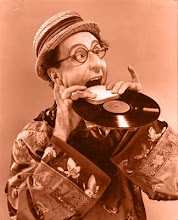
No, the Third Banana isn't dead...

...but it's not feeling at all well. I'm short on time, especially in the wake of Hurricane Ike, and worse, my DVD player has fried itself which is putting the kibosh on new video content (sorry Geoff). Until I can scrape together the cash for a new DVD player, I'd like to draw your attention to some of the new Third Banana-y content now available at archive.org.


Lady of Burlesque (1943). Nothing against Pinky's 50s kidvid, but he's much more fun when playing to adults. He even gets the fade-out here. I can remember when I was willing to shell out good money for a crappy VHS copy of this film just so I could watch Pinky Lee in his burlesque prime and now here it is FREE on the internet. You kids today have it soooo easy.


Poor Daddy (1929). How's this for a rarity; a 1929 silent Chinese comedy feature. Poor Daddy is actually more of a melodrama than a proper comedy. Pretty fascinating but don't expect belly laughs. English and Chinese intertitles.


King Kelly of the USA (1934). In its original incarnation with Trem Carr at the helm, Monogram was easily Hollywood's most daring Poverty Row studio, producing mid-budget adaptations of literary classics such as Jane Eyre and Oliver Twist and slick crowd-pleasing dramas like The Avenger. King Kelly of the USA is probably Monogram's comedy masterpiece and, with its expansive sets, large cast, and clever script, could easily pass as an RKO or Paramount product. The giveaway is that Monogram's stars are the other studios' second-stringers, skilled stalwarts like Edgar Kennedy, Ferdinand Gottschalk, and Franklin Pangborn. A nice fit with other "crazy kingdom" movies of the early 30s (and it seems like Edgar Kennedy is in almost all of them). Probably unique for Monogram, King Kelly also boasts a brief animated sequence (around 20 minutes in) and if limited made-for-TV animation existed in 1934, this is precisely what it would look like. Anyone know who's responsible?

Labels: , , ,

Wednesday, July 11, 2007

Hold 'Em Jail

I'm bogged down with work this week so I'm posting a clip that doesn't need much setup. This is the single funniest sequence from Wheeler and Woolsey's 1932 prison movie spoof, Hold 'Em Jail, and one of Edgar Kennedy's all-time greatest moments. Wonderfully, Edgar is already frustrated as hell and doing the "slow burn" before Bert and Bob even enter the scene.

Labels: , ,

Wednesday, June 06, 2007

"Twin brother to a chicken!!!"

Classic comedy workhorse Edgar Kennedy stars in this 1937 Jam Handy safety short for Chevrolet. In The Other Fellow, poor Edgar finds himself bedeviled by a colorful variety of poor drivers, all played by Edgar Kennedy. "Why, they're in my head! Everywhere!" says Edgar before looking into his rear-view mirror and realizing.. that he's Edgar Kennedy as well! "Well, I'll be a..." mutters Ed, apparently never having seen his own reflection before. Edgar eventually ends up in an altercation with another driver (not played by Edgar Kennedy) after a fender-bender and is quickly hauled away by police as children stand by and laugh at him. "You know we all can improve driving conditions only when we see in ourselves a reflection of the other fellow." the judge tells him. "We won't be so quick to jump on him when we realize that we, ourselves, are the other fellow." On this film's archive.org page, commenter "hauber" mentions another Jam Handy safety short entitled Sitting Pretty (1940) that stars Harry Langdon! Does anyone out there know its whereabouts?

Labels: ,

Tuesday, May 22, 2007

Let That Be a Lesson To You: Ted Healy in Hollywood Hotel

Ted Healy blew the bulk of his film career at a studio with no feel for comedy, finally found his niche on a loan-out, and then was killed less than a month before his greatest screen appearance had reached the public. It's not as though MGM didn't have its perks. Although he was generally handled as a utility comic, from the beginning the studio was willing to cast Healy in dramatic and semi-dramatic roles that helped boost his stock as a flexible character actor (and kept him extremely busy). Although Ted's dramatics are quite good in Stage Mother (1933) and Death On the Diamond (1934), his real strength was comedy, and MGM rarely delivered on that front. Warners, on the other hand, certainly did, and Ted's rough, streetwise persona was a neat fit for the Warners house style. So in 1937, Ted found himself at Warner Brothers, teamed with Dick Powell for a pair of major musical comedies; Varsity Show, directed by William Keighley, and Hollywood Hotel, directed by Busby Berkeley. It's a whole new world for Ted, and you can tell from the renewed gusto in his performances that he knew it. Warners was also clearly happy to have Ted on board. He's second-billed in Varsity Show, and while he's fourth-billed in Hollywood Hotel, he has even more screentime; so much, in fact, that the film is essentially a Powell/Lane/Healy vehicle. Varsity Show is terrific (and better than anything he appeared in at MGM) but Hollywood Hotel is far and away Ted's finest hour. He sings, he clowns, he shares the film's centerpiece musical number, "Let That Be A Lesson to You", with Dick Powell and Rosemary Lane, and Ted even "gets the girl" at the end (in this case the wonderfully weird Mabel Todd). Contrary to what you may have heard, by 1937, Ted was far from washed-up and adrift. He was a genuine box office draw appearing in huge roles in major musicals for one of Hollywood's Big Three. Any reassessment of his career should begin exactly here.

Ted meets Louella Parsons (no, she can't act worth a damn) in an elevator. SLAP! "Hey, Parsons!"


"... I like you on account-a ya got such a nice swollen face!" Ted's first scene with Mabel Todd, a stooge with a difference. In a just world, Todd and Healy would have made a dozen films together. Ted's throwaway lines and comebacks are priceless.


My favorite musical number of all time! Drive-ins!! Benny Goodman!!! Hamburgers! Poodles doing tricks!! Johnnie 'Scat' Davis!!! Richard Whiting and Johnny Mercer!! TED HEALY TORMENTING EDGAR KENNEDY!!!!! Powell and Healy imitating the Kennedy slow-burn!!!! MGM could never have made a number like this.


It would be a sin not to include the scene that follows. Ted so often played semi-straightman to other comics that it's incredible to see none other than Edgar Kennedy do the same for him! A whole new world, indeed!

Labels: , , , , , ,

Saturday, June 17, 2006

Will Hay and his Comedy Divine - a Good-Looking Englishman's Perspective

by Geoff Collins

Well, after Aaron's article, what else could I call it?

Will Hay's entitlement to Third Banana status is fully justified, even in sleepy old England. Most of his movies are available on DVD here with the exception of some early ones and the elusive single-print Fox masterpiece Where's That Fire? - but they hardly ever appear on television, so poor old Will is just as obscure now in his native land as the rest of his contemporaries. It has to be said, though, that he's always been regarded over here as a bit special; it's rare indeed for a middle-aged comedian with such non-existent romantic appeal to have such a successful film career. As Aaron points out, this has much to do with the fact that Hay is always a real person. Apart from his closing remarks to the audience in The Ghost of St. Michael's, he's always within the film, earnestly but inefficiently trying to get on with whatever job he has to do in the mistaken belief that his superiors are blind to his ineptitude, while simultaneously using whatever nominal authority he has in order to generate a bit of extra cash for himself through some minor scam. Unlike Robb Wilton, another comedian who specialized in bumbling officialdom, Will knows deep down inside that he's been promoted far beyond his capabilities, but he feels that he's sharp enough to bluster his way out of trouble if his failings are exposed. His subordinates, insolent fat teenager Graham Moffatt ("Albert") and venerable rascal Moore Marriott ("Harbottle"), if anything even more dishonest than Hay himself, are quite happy to rob and blackmail him, and each other, if the opportunity arises. We've all known people like this.

This, then, is The Secret of Will Hay: he was a great actor as well as a great comedian. He doesn't seem to be acting at all, never appears to be trying to be amusing. It's the art that conceals art. Kenneth Williams knew this; he was flamboyant and artificial, which explains his deep dislike for Sid James who turned up and gave a flawless reading of the lines with the minimum of apparent effort, so he could get paid and get on the phone to the bookie. And let's not forget the obvious fact that Moffatt and Marriott were Hay's equal in film technique.

So, yes, Hay, Moffatt and Marriott are the British equivalent of the Marx Brothers; far more acceptable candidates than the usual contenders for the title, the Crazy Gang. The Gang, three mid-life double-acts of variable quality (Flanagan and Allen at one end of the scale; Naughton and Gold very definitely at the other) made their movies at the same studio (Gainsborough) and at the same time as Will Hay, and sometimes with the same director and writers (Marcel Varnel; Edgar, Orton, Guest) and they are excellent, funny films; but the Gang are pure Music Hall, overstated and stagey, whereas Hay and his stooges, despite the farcical situations, always inhabit the real world. Buggleskelly, Bishop's Wallop, Turnbotham Round; they seem like real English (or Irish) villages where Hay's petty bureaucracy and mismanagement would be accepted and cherished. In a perfect world Hay would have stayed at Gainsborough with his two cronies and made beautiful comedies all through the war (can you imagine the Turnbotham Round Home Guard, with Hay as Captain Dudfoot? Bliss!) But he didn't. He abandoned Moffatt and Marriott and turned out some efficient but far less outstanding comedies for Ealing in which, deprived of his sidekicks, he always seems a bit lonely. However! There was enough time left for one genuine classic: My Learned Friend. In this blackest of black comedies, made during the war but with no internal reference to the conflict, Hay is teamed once more with dithery drip Claude Hulbert, and he's a barrister on the run from a homicidal maniac. If this isn't enough, it features probably the nastiest baddie in all black-and-white movie-comedydom [what???]; razor-wielding London gangster "Safety" Wilson. Ugh! But Hay and Hulbert end up on top - on top of Big Ben, actually, in a climax oddly borrowed years later by the Robert Powell Thirty-Nine Steps.

Aaron mentioned the reluctance of the American film companies to give Stateside promotion to the product of their own British studios (another example being the Max Miller's Warner quickies which are unfathomable outside the southern half of England). Yet Where's That Fire? was made by 20th Century Fox, albeit with the full Gainsborough team, and only survives because a print turned up in the Fox vaults in Hollywood. How ironic that the finest film (I agree with you, Aaron) of this so-English comedian should be re-discovered after thirty-five years, six thousand miles from home in a land Will Hay should have conquered, but didn't. It's the culmination of all that Hay, Moffatt and Marriott did best: seamless script and direction, and such natural performances from the three stars that it makes you want to live there (unless your house catches fire); and comedy sequences (not "routines") of such pure joy that you find you're not laughing - you're absorbing it.

When the Marx Brothers tried to play Real Human Beings they produced things like Room Service. Don't misunderstand me; I think the Marxes are wonderful. Hay, Moore and Marriott, equally wonderful, brought about their anarchy from inside the real world, by undermining stuffy old 1930s England where order and efficiency mattered. Did it really? Or were we a suppressed nation, waiting for all that dull Ealing-type crap to get out of the way so we could get to the 1960s? Will Hay was the most popular English comedian of his time, and I believe this is because (a) the crafty old bugger was absolutely real, and (b) we'd all like to be as devious and shifty and sloppy as he is and (c) get away with it. If Ask a Policeman has a flaw, this is it: Hay and his pals don't get away with it. In Where's That Fire? they do.

There's not enough space in this one article to discuss Hay's early movies, before he encountered the Dynamic Duo, but they're mostly unsuccessful attempts at trying to find a "persona" for him. Three or four films in, someone realized it was there all the time: the seedy schoolteacher was adaptable to any kind of tatty authority. Needless to say, in these early efforts Hay's acting is always exemplary, even when he isn't funny at all (as in Radio Parade of 1935).

Nor is there space to examine the fact that the "pupils" in his schoolmaster act on the halls invariably comprised a lippy "Albert" and an ancient "Harbottle"; and that Moffatt and Marriott were the perfect cinematic replacement for long-forgotten stage stooges. These characters existed long before Gainsborough, and the proof is there on Hay's 78rpm records of 1929, and a brief 1928 newsreel clip available on www.britishpathe.com. Have a peek; it's not Marriott on there, but it looks just like him.

Ditching Moffatt and Marriott was probably the greatest mistake of Hay's career; but on the basis of the six movies he made with them, he's entitled to eternal membership of the Third Banana. So move over Ted, Joe, Bert, Cliff... and let another Englishman join your ranks. And what will be his first words on arrival? He'll peer over his glasses, give everybody the Dreaded Stare, sniff, shrug his shoulders and say:

"Good morning, boys!"

Labels: , , ,

Monday, June 12, 2006

Will Hay and the Comedy Divide: an Ugly American's Perspective

Thanks to the endless wonder that is the Electromatic Interweb, I've now seen the (near) entirety of Will Hay's film oeuvre (an early short was missing from the DVD set and may be missing in general). We've mentioned Hay at least a few times here but haven't yet truly given the man his due, partly because poor old Will Hay exists in some shadowy netherworld between proper comedy stardom and true Third Banana status. In Britain, he remains the home-grown icon of 30s film comedy. On this side of the Atlantic, Will Hay remains an obscurity.. a bit surprising given not only his accessibility as a comedian, but the decidedly "American" tone of his best work. As an official Hawaiian shirt-wearing Ugly American, I must bestow upon poor Will Hay the Third Banana tag. Who da heck is dis Will Hay, anyway??

If there's any term I would use to describe the bulk of British film comedy of the 1930s, it would be "self-conscious". A deep-rooted sense of tradition is one of the hallmarks of the British music halls, and I believe that this awareness of purpose may have been a factor behind the rather perfunctory air that so much British comedy of the 30s and 40s suffers from. This is not always a refection on the comedians themselves. Arthur Askey is a wonderful, sprightly ultra-comic who makes a huge, obscene joke out of the very act of cracking jokes. The team of Flanagan and Allen, the "Oi!" comedians, engage in mindbending doubletalk routines that sound like Abbott and Costello on speed and then turn around and sing lilting songs that gush sincerity. But for every Bud Flanagan, you have a Charlie Naughton.. maybe two.. maybe more. Comedians who had been called upon to repeat the same routines for so long that they can no longer feel it. They're no longer comedians at that stage. They're performers playing comedians. And, most unfortunately, this self-consciouness seeps into the films, no matter how good the starring comedians may be, manifesting as a kind of tightly-controlled zaniness. Even the best British comics, such as the wonderful George Formby, fought an uphill battle against the rote nature of their film vehicles to no avail. To American eyes and ears, all this self-consciousness violates one of our key expectations from comedy. In America, then as today, entertainers were seen as largely inseparable from the individual. If comics wore a mask when they entertained, it was a slightly caricatured one that revealed some basic truths about the very real person who wore it (Eddie Cantor went one step further by blurring the line between the entertainer's private life and his performances). There was little room for tradition in a world of self-defined iconoclasts. And if the entertainer was seen as inseparable from the entertainer, the entertainer was to be inseparable from the films they appeared in. After the Marx Brothers moved to Hollywood, the scripts for their films became, for a time, free-for-all workshops for some of the nation's finest humorists. The end results bore little resemblance to anything preceding them; they are, undeniably Marx Brothers Movies to the core (and is it any wonder that their least successful comedies, Love Happy and Room Service, weren't originally written as "Marx Brothers Movies"?). The upshoot of this comedy divide was that, in the 30s, American comedies exported to the UK with more ease than vice versa. British audiences simply embraced the artistry of those American acts they liked. As many successful American acts in the UK discovered, this appreciation for skill translated into an overwhelming preference for repetition of that skill. Burns and Allen, for instance, were called upon to repeat the same material endlessly by doting audiences. In America, however, it was as though British comedy did not exist. There wasn't a blanket ban on British imports, but there might as well have been. Most American studios had affiliates, if not wholly-owned subsidiaries, in the UK churning out product tailored to native tastes so it would have been a simple matter to import those films. One must imagine that the studios at least test-screened some of these comedies for select audiences. After all, it would have been within the studios' interests to turn as much of a profit as possible on films that, in many cases, they owned outright. But, ultimately, the studios must have realized the problems posed by the comedy divide. Even when not hopelessly self-aware, the rather gentle nature of most British comedies would have held little appeal to audiences with a taste for the extreme, and those British comedies that aspired to the extreme were the most self-conscious of all, bordering on neurotic. And so it was that Joe E. Brown was a household name in the UK, while George Formby was about as well-known in the US as the guy who cleaned the toilets at the Conoco station down the street.

But Will Hay was a different matter.. or he should have been. One of his films, Hey, Hey, USA! (1938) co-stars Edgar "Slow Burn" Kennedy and was certainly made with the American market in mind. Another, Where's That Fire? (1940) was produced by 20th Century Fox (the only surviving print was found in that studio's film vault in the 1970s). There's also evidence that a few of Hay's films received limited US distribution. What set Hay apart from all those acts that had no hope of entering the US market? To start with, Hay's comedy skills were so great as to override the self-consciousness that make acts like Nervo and Knox, talented as they were, seem so packaged. His natural comic's sensibilities are apparent in his impeccable sense of timing and pantomime, but unlike American comics such as Ted Healy, whose screen characters are reflections of their true personalities (frighteningly enough), Hay's doddering, shifty persona is pure performance. In this regard, Hay's methods are much like those of fellow Karno alumnus Stan Laurel and Charlie Chaplin whose instantly recognizable characters are similarly a matter of skillful performance rather than channeled behavioral tendencies. Thus there is no more self-consciousness about Hay's comic performances than there is about, say, Jimmy Stewart's dramatic ones. Hay performances "read" as sincere. Just as importantly, Hay's finest movies are wild and, atypically for British comedies of the 30s (but not for American ones), rather ruthless. Although Hay began his film career often playing mild characters in equally mild (to say nothing of mechanical) farces, he soon found his footing as an hilariously amoral opportunist in comedies that rivaled the Marxes in pure anarchic abandon. Hay, who bears a resemblance to Boris Karloff, is all bluff, cringing from those with more power and bullying those with less. He's a fount of ignorance, willing to talk at length about things of which he has absolutely no understanding, and if you call him on it, he'll simply shout you down or give you the Dreaded Glare. He's a tin-pot schemer, wheedling his way into places he has no business being and reaping the whirlwind as a result. Sounds awful, doesn't he? Beware! Hay makes you like and sympathize with the crusty old sod, and not by exposing his character's "wounded inner-child" or whatever, either. You want to see Hay come out on top because, dammit, he's a real person; more real than the plastic nobodies or summer stock villains who own and operate the terribly capricious world he lives in. He represents flawed humanity's inalienable right to be flawed.

Furthering the American similarities, in his best comedies Hay is aided and abetted by two stooges, Graham Moffatt and Moore Marriott. The Crazy Gang has often been described as the UK's answer to the Marx Brothers, but that's a pack of dirty lies! LIES! Hay, Moffatt, and Marriott are the UK's answer to the Marx Brothers, and they have the dignity to go about their business as though the question were never asked. Graham Moffatt had been playing comic choir boys, page boys, and office boys in films from the tender age of 14 and, in Hay's comedies, he blossomed into a rotund, lazy, squeaky-voiced conniver, on a mission from Hell to make misery for his elders. There was no elder more elder than his unlikely partner Moore Marriott, a toothless, foolish old fossil played to the hilt by a man in his early fifties (who was, admittedly, toothless). The trio, with Hay as ringleader, were vehicles for a brand of slapstick anarchy that Hay seemed incapable of as a solo. As policemen, firemen, sailors, or railway station porters, Hay, Moffatt and Marriott are models of dimwitted graft and inefficiency, engaged in an eternal corruption competition, but pulling together in times of crisis. Unfortunately, the temperamental Hay began to fear that he was simply becoming one third of a comedy team. He made a concerted effort to shake off Moffatt and Marriott in 1938 before finally succeeding by switching studios from Gainsborough to Ealing in 1941. But new stooges like Charles Hawtry and Claude Hulbert did little to compliment Hay's style, and, as far as I'm concerned, neither did Ealing where he spent the brief remainder of his career. Moffatt and Marriott remained at Gainsborough, stooging for such comedians as Arthur Askey.

That Will Hay remains an obscurity in the US remains a mystery, and it seems he's overdue for discovery here. Granted, the entire purpose of The Third Banana is to bring to light comedians who we feel have been unjustly forgotten, but we also understand the limited appeal of many comics no matter how much we may love them. But Will Hay represents a rather extreme case of Third Banana-itis. There was certainly little chance for success for Hay's films in the US during the 30s when there was scarce opportunity for Hay to engage in the kind of promotion that would have brought him to the American public's attention. As an unknown quantity, it would have taken a leap of faith on the part of any studio to build up Hay as a comedy star in the first place, no matter the quality of his films. But today, in our ever dwindling world, one would think that some enterprising soul would give Hay's films an official stateside release, or at least a little airplay on TCM. Who knows? It may happen yet.

And what about the Great Comedy Divide? World War Two caused seismic shifts in British comedy tastes. The horror of war on the homefront was followed by years of rationing and going without. The love of the predictable was soon supplanted by a growing preference for the unexpected. They received it in the form of the Goons who, molded and inspired by their war experiences, established a new trend in British comedy with their anarchistic and original BBC radio series. The iconoclasts had finally taken over, ultimately giving birth to such institutions as Monty Python and The Beatles. Air-conditioned and freshly mowed post-War America, meanwhile, discovered a taste for the domestic and learned to eschew innovation in favor of focus groups.

Anyway, for those who care, here are my top Will Hay picks:

Windbag the Sailor (1936): Directed by the infamous William Beaudine, who even gets an additional dialogue credit (for which lines?)! Hay is a former canal barge skipper whose tall tales of the sea secure him an unwanted job as captain on a boat, the owner of which intends to scuttle. Hay is teamed for the first time with both Moffatt and Marriott, whose regular screen characters haven't yet quite gelled (Marriott, in particular, plays Harbottle as rather sharp-tongued here, a trait that would be quickly dropped). Features a very funny scene in which all three try to chart the ship's location using some decidedly twisted logic.

Oh, Mr. Porter! (1937): Considered by most to be Will Hay's masterpiece, and it may well be, although I find Ask a Policeman and Where's That Fire? funnier. Oh, Mr. Porter! is beyond doubt the best-looking and best-directed of Hay's features. Hay plays a ne'er-do-well railway "wheel-tapper" who is promoted to stationmaster of the tiny Irish town of Buggleskelly. Moffatt and Marriott are the station's wildly unprincipled regular staff, living off the food they steal from deliveries, and are not at all keen on Hay's attempts to make the station respectable. Hay and co. foil a gang of gun runners using a local ghost story as a cover for their activities.

Ask a Policeman (1939): A great anti-establishment film that features Hay, Moffatt and Marriott as thoroughly corrupt policemen in the tiny town of Turnbotham Round. Sergeant Dudfoot (Hay) hasn't bothered to make an arrest in years, giving the town an extremely false reputation as one of the most law-abiding in the nation. In fact, he's made his job, and those of officers Albert and Harbottle (Moffatt and Marriott) superfluous, and they find they must invent crimes and create false evidence in order to save their careers. Eventually Hay and co. foil a gang of smugglers using a local ghost story as a cover for their activities. Hmm. More wonderfully twisted logic in the sequence in which they set up a speed trap and try to deduce how fast a driver was traveling.

Where's That Fire? (1940): My personal favorite. Hay, Moffatt and Marriott are incompetent firemen in the town of Bishops Wallop who are ordered by the city to improve their antiquated station after they accidentally permit the Town Hall to burn to the ground. After visiting a modern London fire station for inspiration (and pocketing a few loose items, such as an alarm and a fire axe), the boys decide to install a pole. The Great Fire Pole Sequence features Hay, Moffatt, and Marriott blocking traffic and smashing up a china shop across the street as they attempt to maneuver the pole into place, giving scant regard to the chaos they're causing. Probably the greatest sustained comedy sequence of Hay's film career. The film concludes with Hay and co. foiling a gang of crooks who are using their station's antique engine, a duplicate of the one at the Tower of London, to steal the Crown Jewels.

Notable misfires:

Hey, Hey, USA!
(1938): Will Hay attempts to enter the American market and replace Moffatt and Marriott in one go and fails on both counts. After a series of misadventures, Hay, a ship's porter, ends up posing as a noted professor on a voyage to the US and is quickly employed by a rich American passenger as a tutor for his bratty son. Meanwhile, stowaway Edgar Kennedy is a member of a gang who intends to kidnap the boy for ransom. Grating farce follows. Kennedy reacts to Hay's mildly dotty malapropisms and misunderstandings as though Hay were Harpo Marx or Bert Wheeler. His extreme overreactions can be extremely funny, but Hay is far too mild here to warrant them making Kennedy seem more than a little unbalanced. In fact, at the close out, he literally goes mad and is carted away! Ironically, Hay would have had a much better chance at entering the US market with Oh, Mr. Porter!.

The Ghost of St. Michaels (1941): Hay's first film for Ealing features him in his famous music hall schoolmaster role, but Charles Hawtry and Claude Hulbert, as a pupil and fellow teacher respectively, are no substitutes for Moffatt and Marriott. Moreover, the screenplay is pure B-movie hash, spending far more time on the inanities of the thin "mystery" plot than on comic set pieces. What comedy sequences we do get are strangely off-putting. Hay's victimization at the hands of his pupils comes across as more cruel than funny, especially as Hay is here at his most innocuous. Hay's breaking of the "fourth wall" at the end when he addresses the audience is charming, though.

Labels: , , , , , , ,