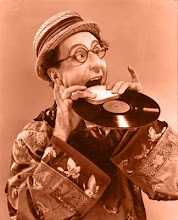
Ed's, You Win!
 by Geoff Collins
A nasty rumour has been circulating around these parts that our devoted readers couldn't care less about Ed Wynn. Shame!!! Come on, you guys, what's the matter with you? It's not as if we haven't provided the evidence. And besides, here's a bit more:
If you're English, the next few words will make you laugh. I guarantee it.
Dick Van Dyke in Mary Poppins.
Okay, that's enough. Get up off the floor, put your teeth back in and pull yourselves together. Now let's analyze it. What immediately comes to mind? The most notoriously bad fake Cockney accent in cinema history (purists are welcome to make a case for Harry Watson in A Damsel in Distress. Ohhhhh God, that's dire.). "It'll be all roight, Mary Pappins" - accompanied by a regrettable tendency to break into a knees-up at the slightest provocation. Can I let you into a little secret? Londoners aren't like that! Trust me - I've been having a great time with one of 'em for the last seven years. Mimics have spent the last four decades squeezing the maximum hilarity out of chimney-sweep Bert's haphazard inflections - which is a bit hard on Dick Van Dyke, who must have known about it, because in Chitty Chitty Bang Bang, despite having an "English dad" (Lionel Jeffries, in real life a year younger than "his son", Dick), he doesn't bother with it at all and keeps his own American accent all the way through. In the States (I'm guessing here) Dick's appreciated for his fine early-sixties sitcom; but in Britain he's a Third Banana. Not fair! Is there any way we can justify his strangulated performance? Well, let's try.
Mary Poppins is set in 1910s London. Just Imagine [oh no, not that again] if you will, that lurking behind a nearby lamp-post, notebook in hand, is Rex Harrison as Professor Henry Higgins, bemused by the fact that Julie Andrews is in this film instead of his. What would he make of "Bert"? "Hmmmmm....... mother from East London. Father...."
I first saw Mary Poppins when I was eight years old, and I recall being really disappointed because the cartoon sequence was early in the film and (to an eight-year-old) it really dragged after that. Yet there was another high point - when they all go to see Uncle Albert. Let's assume he's Bert's dad's brother; Bert's obviously named after his uncle (as I was named after my uncle Geoff; thank God; my dad is Bill, but his full name is Wilfred). Uncle Albert is eccentric, he's funny, he floats up to the ceiling when he laughs, and he's played by Ed Wynn. I remember my dad whispering to me, in the cinema, "that's Ed Wynn", but then he always liked to point out all the obscure character people (he still does this!). I didn't know who Ed Wynn was, but - ooooohhh! what a star turn this is. Readers: find the DVD and watch it now!
See what I mean? Not only is this Ed's finest five minutes in pictures (all Third Bananas deserve an opportunity like this) but it also provides the obvious answer to why Dick Van Dyke's character is such an odd-voiced hybrid: his uncle's a Jew from Philadelphia!
We've already bemoaned the fact that the Disney organization has a lot to
 answer for in the case of "Jiminy Cricket" Cliff Edwards. His contribution was vast but they kept him anonymous. On the plus side, Disney definitely looked after Ed Wynn. Starting with his voice-over in Alice in Wonderland (and I can't help wishing that the Mad Hatter looked a bit more like Ed) he was in The Absent-Minded Professor, Son of Flubber, Babes in Toyland, Mary Poppins (obviously), Those Calloways, That Darn Cat (very funny film; check it out) and The Gnome-Mobile. He's in that small, select group of star comedians (Arthur Askey, Jimmy Durante and Ed) whose sheer longevity gave them two entirely separate periods of movie fame. After the glories of Follow the Leader (more on this one later!) and the disastrous The Chief, there was a long gap, punctuated by one or two good gags in Stage Door Canteen, until the late 1950s. In between, he did exceptionally well on early radio (1933) and early TV (1949-50). The double-act of "Wynn and Keaton", spookily re-creating Buster's movie debut (the molasses routine from The Butcher Boy) for Buster's TV debut (December 1949), is easily the equal of "Chaplin and Keaton" in Limelight. Sublime, superb, perfect comedy.
I haven't said much about Ed's character. Tall, balding, bespectacled, giggly, fond of ridiculous hats, props and costumes, he was endearingly silly. That's it, really; he was a middle-aged Silly Man. Offstage Ed was morose and depressed with a tendency towards alcoholism, which led to some bad decisions, such as turning down the title role in The Wizard of Oz (yes, we all know that Frank Morgan is perfect, but....and here's the double whammy: Bill Fields turned it down too). Ed's underlying sadness is always apparent in his work but it's never an issue as it all adds to his vulnerability and warmth. His age didn't matter. He didn't need to be handsome; he looked the same in Follow the Leader as he did in Stage Door Canteen, and in his 1950 TV shows. He improved with age, so by the time of Mary Poppins he was about the most lovable comedian on the planet; and it showed.
We can only hope that by this time, Ed was as happy on the inside as he looked on the outside. After sixty years devoted to the laughter of others, he deserved it.
We can also hope that Aaron will now provide some evidence, in order to bring you, our readers, the Who Cares About Ed Wynn Society, out of your apathetic state. Never forget this: our Third Bananas spent their entire lives making the world a funnier place; and we're doing our best to prove this. Ed Wynn, bless him, always Did His Best. Enjoy his work whenever you can find it.
 How's this, Geoff? Recorded through a telescope off the two-inch screen of a Baird mechanical television with a coal-powered camcorder, I'm proud to present the first nine minutes of Ed's 1930 talking debut, Follow the Leader. That's the aforementioned Lou Holtz as Sam Platz. Follow the Leader was, I believe, shot side-by-side with Animal Crackers at Paramount's Astoria Long Island studio. The opening titles even share Animal Crackers' art deco styling and wonderful jazz violin. -A
posted by Aaron Neathery at 5:35 PM
5 comments