Sunday, December 09, 2007

The Gazeeka Box!

Perhaps you've already noticed the obtrusive white widget midway down the sidebar but, if not, let me introduce the Third Banana's "Gazeeka Box", a new feature that will allow us to more easily share music and OTR with you. All of the files listed therein can be downloaded to your desktop (click the blue arrow on each file listing) or can be played through the widget itself. As a Yuletide gift to you, the box is currently full of holiday-themed goodies from Jerry Lewis, Abbott and Costello, Ed and Keenan Wynn (and many others on the Blue Network Christmas special), Phil Harris and Alice Faye, Jack Benny, Kukla, Fran, and Ollie, Eddie Cantor, The Three Stooges, as well as a few ancient 78s. Enjoy!

Labels: , , , , , , , , , ,

Wednesday, July 18, 2007

Ed's, You Win!

by Geoff Collins

A nasty rumour has been circulating around these parts that our devoted readers couldn't care less about Ed Wynn. Shame!!! Come on, you guys, what's the matter with you? It's not as if we haven't provided the evidence. And besides, here's a bit more:

If you're English, the next few words will make you laugh. I guarantee it.

Dick Van Dyke in Mary Poppins.

Okay, that's enough. Get up off the floor, put your teeth back in and pull yourselves together. Now let's analyze it. What immediately comes to mind? The most notoriously bad fake Cockney accent in cinema history (purists are welcome to make a case for Harry Watson in A Damsel in Distress. Ohhhhh God, that's dire.). "It'll be all roight, Mary Pappins" - accompanied by a regrettable tendency to break into a knees-up at the slightest provocation. Can I let you into a little secret? Londoners aren't like that! Trust me - I've been having a great time with one of 'em for the last seven years. Mimics have spent the last four decades squeezing the maximum hilarity out of chimney-sweep Bert's haphazard inflections - which is a bit hard on Dick Van Dyke, who must have known about it, because in Chitty Chitty Bang Bang, despite having an "English dad" (Lionel Jeffries, in real life a year younger than "his son", Dick), he doesn't bother with it at all and keeps his own American accent all the way through. In the States (I'm guessing here) Dick's appreciated for his fine early-sixties sitcom; but in Britain he's a Third Banana. Not fair! Is there any way we can justify his strangulated performance? Well, let's try.

Mary Poppins is set in 1910s London. Just Imagine [oh no, not that again] if you will, that lurking behind a nearby lamp-post, notebook in hand, is Rex Harrison as Professor Henry Higgins, bemused by the fact that Julie Andrews is in this film instead of his. What would he make of "Bert"? "Hmmmmm....... mother from East London. Father...."

I first saw Mary Poppins when I was eight years old, and I recall being really disappointed because the cartoon sequence was early in the film and (to an eight-year-old) it really dragged after that. Yet there was another high point - when they all go to see Uncle Albert. Let's assume he's Bert's dad's brother; Bert's obviously named after his uncle (as I was named after my uncle Geoff; thank God; my dad is Bill, but his full name is Wilfred). Uncle Albert is eccentric, he's funny, he floats up to the ceiling when he laughs, and he's played by Ed Wynn. I remember my dad whispering to me, in the cinema, "that's Ed Wynn", but then he always liked to point out all the obscure character people (he still does this!). I didn't know who Ed Wynn was, but - ooooohhh! what a star turn this is. Readers: find the DVD and watch it now!

See what I mean? Not only is this Ed's finest five minutes in pictures (all Third Bananas deserve an opportunity like this) but it also provides the obvious answer to why Dick Van Dyke's character is such an odd-voiced hybrid: his uncle's a Jew from Philadelphia!

We've already bemoaned the fact that the Disney organization has a lot to answer for in the case of "Jiminy Cricket" Cliff Edwards. His contribution was vast but they kept him anonymous. On the plus side, Disney definitely looked after Ed Wynn. Starting with his voice-over in Alice in Wonderland (and I can't help wishing that the Mad Hatter looked a bit more like Ed) he was in The Absent-Minded Professor, Son of Flubber, Babes in Toyland, Mary Poppins (obviously), Those Calloways, That Darn Cat (very funny film; check it out) and The Gnome-Mobile. He's in that small, select group of star comedians (Arthur Askey, Jimmy Durante and Ed) whose sheer longevity gave them two entirely separate periods of movie fame. After the glories of Follow the Leader (more on this one later!) and the disastrous The Chief, there was a long gap, punctuated by one or two good gags in Stage Door Canteen, until the late 1950s. In between, he did exceptionally well on early radio (1933) and early TV (1949-50). The double-act of "Wynn and Keaton", spookily re-creating Buster's movie debut (the molasses routine from The Butcher Boy) for Buster's TV debut (December 1949), is easily the equal of "Chaplin and Keaton" in Limelight. Sublime, superb, perfect comedy.

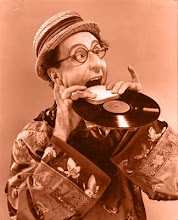
I haven't said much about Ed's character. Tall, balding, bespectacled, giggly, fond of ridiculous hats, props and costumes, he was endearingly silly. That's it, really; he was a middle-aged Silly Man. Offstage Ed was morose and depressed with a tendency towards alcoholism, which led to some bad decisions, such as turning down the title role in The Wizard of Oz (yes, we all know that Frank Morgan is perfect, but....and here's the double whammy: Bill Fields turned it down too). Ed's underlying sadness is always apparent in his work but it's never an issue as it all adds to his vulnerability and warmth. His age didn't matter. He didn't need to be handsome; he looked the same in Follow the Leader as he did in Stage Door Canteen, and in his 1950 TV shows. He improved with age, so by the time of Mary Poppins he was about the most lovable comedian on the planet; and it showed.

We can only hope that by this time, Ed was as happy on the inside as he looked on the outside. After sixty years devoted to the laughter of others, he deserved it.

We can also hope that Aaron will now provide some evidence, in order to bring you, our readers, the Who Cares About Ed Wynn Society, out of your apathetic state. Never forget this: our Third Bananas spent their entire lives making the world a funnier place; and we're doing our best to prove this. Ed Wynn, bless him, always Did His Best. Enjoy his work whenever you can find it.

How's this, Geoff? Recorded through a telescope off the two-inch screen of a Baird mechanical television with a coal-powered camcorder, I'm proud to present the first nine minutes of Ed's 1930 talking debut, Follow the Leader. That's the aforementioned Lou Holtz as Sam Platz. Follow the Leader was, I believe, shot side-by-side with Animal Crackers at Paramount's Astoria Long Island studio. The opening titles even share Animal Crackers' art deco styling and wonderful jazz violin. -A

Labels: , ,

Tuesday, April 24, 2007

Be Sure Every Boy and Girl Reads This Book


In 1934, the Goldsmith Publishing Company of Chicago produced a series of three BLB-format childrens' books featuring the top kid-friendly radio comics of the day, Ed Wynn, Eddie Cantor, and Jack Pearl. Goldsmith published a fourth book, Joe Penner's Duck Farm, the following year, just in time to cash in on Joe's meteoric decline which may account for why the book seems to be so scarce today (the others, which reportedly sold in the millions, are fairly common). All four stories were written by juvenile author Harold M. Sherman, a pretty interesting guy in his own right (his career included writing the play Mark Twain and extensive experimentation with ESP) and were supposedly devised with an assist from the stars themselves. This is, of course, unlikely, but the little "memos" (on each star's own stationary) that open and close each story do seem strangely authentic.

Cantor's memos, for instance, are terse and businesslike. I can just imagine some kid in 1934 thinking "This book and story was developed under Eddie Cantor's personal supervision?? Golly!" And as Eddie Cantor in Laughland depicts Eddie as an epoch-shifting godhead, perhaps he did have a hand in it.


Jack Pearl's memos just sound right to me for some reason. Maybe it's the faint eagerness in them and his repeated use of the word "friend". I wonder if Jack used Baron Munchausen stationary for the rest of his life. I'm venturing a "yes". Incidentally, Pearl's radio straightman "Sharlie" is also a character in the book although the real Cliff Hall wasn't used as a model for the illustrations. Also incidentally, I just discovered that every image on Jack Pearl's Wikipedia entry was ripped from this blog. Who knew?


Ed Wynn's memos are purely in character. Note that unlike the others, Ed mentions Howard Sherman by name and gives him credit for the story right away. As the story itself depicts Ed's Fire Chief character as endearingly silly rather than dangerously idiotic, it stands heads and shoulders above the wretched 1933 MGM feature. Given the multiple attempts to create narratives around a "character" (which on radio consisted of nothing more than Ed Wynn wearing a fire helmet) that was merely a nod to Texaco Fire Chief Gasolines, the show's sponsor, I've often wondered what would have happened if another company, say Cliquot Club, had sponsored instead. Would Ed have broadcast dressed as an Eskimo? Would there have been "Ed Wynn, Eskimo" toys, books, and boardgames? Would there have been an awful MGM film, The Eskimo? The mind reels...


Labels: , , ,

Thursday, April 12, 2007

Breaking Wynn

For your entertainment and edification, here is the February 5, 1945 episode of Happy Island starring Ed Wynn. As you'll notice, this particular episode sounds like a decidedly average mid-40s radio comedy. Ed is just plain "Bubbles" rather than "King Bubbles", there's absolutely no mention of Happy Island, and there's nothing particularly fantasy-like about the plot (Bubbles is made warden of "the State Prison"). If I had to venture a guess, I'd say that this conceptual, and no doubt budgetary, streamlining was a last-ditch effort to save the show. Good fun, nonetheless, and keep an ear out for a very young Jim Backus who plays at least three roles in this episode, including one who is a definite forerunner of Thurston Howell III.

Labels: ,

Wednesday, April 11, 2007

Gone With the Wynn

January, 1945. This entertaining little puff piece is not advance publicity for Ed Wynn's Happy Island series for Borden's Milk. Happy Island had already been on the air for five months. This article, which I'm sure wasn't penned by Wynn although it reads as though the specifics might have been taken from an interview (or maybe Ed's filing cabinet), was an attempt to drum up interest in a failing program. Happy Island was cancelled the following month and with it went Wynn's radio career. As late as 1944, in the midst of the horrors of WWII, Ed, God bless him, was trying valiantly to keep good-natured fantasy alive. A vaudevillian through and through, Wynn never became comfortable with the concept of "the theater of the mind"; from the beginning, he needed props and full makeup in order to maintain his focus and stay within his element. None of his previous series were as elaborately staged as Happy Island, a program that featured the cast in full costume along with sets, lighting, and special effects. The photos accompanying the article, which were probably taken in Ed's apartment (NY or LA? Does anyone know?), are charming and I have to imagine that the broadcasts must have been a blast to see in person. But all of this additional effort meant absolutely nothing, of course, to listeners at home, and one can presume what the brass at ABC felt about paying for all of Happy Island's production frills when comics like Bob Hope and Jack Benny were content to stand in front of a microphone on a stage and just talk. Not that that would have helped Ed Wynn. In the age of Abbott and Costello, Wynn's lighthearted whimsy was soundly rejected by an increasingly cynical public. There was little room in radio (or elsewhere for that matter) in 1945 for a vaudeville clown who felt that "getting a laugh at the expense of another person is mean and unfair."

Labels: ,

Thursday, March 15, 2007

Up Millcreek (Without a Paddle)

by Geoff Collins

Classic? Musicals??

You know, strange as it may seem, Third Banana writers these days give each other very unusual gifts. Obviously, these presents will have some connection with obscure and often prehistoric comedy which, gnome-like, we can sit and absorb and enjoy unbothered by the shallow whims of popular culture.

As our desire to explore the outer limits of arcane humour takes hold even more, it was with joy that I informed Aaron of my latest find, in a cheapo store in my home town of boring old Bedford, in England: a fifty--film DVD set from Millcreek Entertainment entitled Classic Musicals. First question: how did they get fifty movies into a box set measuring 4x13x19 mm ? Easy; on twelve double-sided DVDs. Some of the films are less than an hour long so these are squeezed three to a side. Next question: Are they Classic Musicals ? Wellll.... Question Three: how did Aaron react when I told him my good fortune? I'll quote from his reply:
"AAARRRRGGGGHHHH!!!! Now I gotta get you another Christmas gift!!!!!! This is just plain Spooky!!!! SPOOKY, I TELL YOU!!!!! Ah, well.."
Calm little chap, isn't he? So clearly this package is available on both sides of the Atlantic. For our British readers, I suggest you try The Works, where it's now reduced to £15. Question Four: how can Millcreek put out fifty movies so cheaply? Because they're all in the Public Domain, that's why. So we have the usual old favourites such as MGM stuff that's somehow avoided copyright renewal (Mr. Imperium, Till the Clouds Roll By, Royal Wedding), mundane oddities with glorious moments (Private Buckaroo, The Fabulous Dorseys, Second Chorus) and quite a lot of absolute crap from Monogram and PRC. The output of PRC is virtually unknown in the UK, which is probably just as well, even the basest of TV channels being unwilling to screen such terminal crumminess. Yet on this set we can see probably their finest hour: Benny Fields in Minstrel Man. Its minstrel-show setting may be flagrantly racist and Benny may be just marginally ahead of Jessel in the faux-Jolson stakes, but he's rare and treasurable. I loved it.

So this set is Highly Recommended to Third Banana readers. Why? Because amidst all that dross - bloody hours of it - there's some wonderful comedy.

For example:

Glorifying the American Girl - one of the most woeful cascades of misery ever inflicted on the American public. The history of this troubled early talkie is covered in some detail in Richard Barrios' A Song in the Dark. Like so many other movies in Millcreek's set, this gloomy backstage sob-story is lacking its Technicolor because it derives from a 1950s TV print made at the time when colour printing wasn't considered a feasible option. Nonetheless, after an hour and a half of Mary Eaton's suffering (or, from the audience's viewpoint, suffering Mary Eaton) We're treated to the full twelve minutes of Eddie Cantor's tailor sketch, "Belt in the Back", filmed, as so many TV sitcoms would be twenty-five years later, in a continuous take using three cameras. It finishes very abruptly (probably the film ran out!) and once or twice the picture slows down and then speeds up again, to most unsettling effect. This is Murphy's Law: The flaws are always during the best sequences (as in Plane Nuts on The Three Stooges Early Years). Readers: check our archive for details of the unsavoury 1949 lawsuit concerning the true authorship of this piece. Who'd have thought that twelve minutes of New York Jewish comedy could arouse such animosity? [And incidentally, who's the little guy playing the customer?]

People Are Funny - and sometimes movies are funny, but not this one, a really, really, really awful Paramount B-picture in which Jack Haley is emasculated and conned out of his rightful property, the People Are Funny radio show. I quote from Millcreek's synopsis:
"His rival Frances Langford (Ozzie Nelson) has plans of his own."
Frances isn't actually portrayed by Ozzie, of course, but she might as well be; her opening "guest star" number is ripped out of the movie in one of the clumsiest cuts I've ever come across. But... joy of joys (no, cancel that; it isn't that thrilling) we get a glimpse of Joe De Rita with hair, as an unwilling victim of "amusing" audience participation. It's near the end; use the fast forward button... please!

Breakfast in Hollywood. My dad really liked this movie, based on genial Tom Brenaman's morning radio show, and his judgment's correct: it's competent and pleasant. We've commented before on the number of lesser-lights [and even Besser-lights] who've copied Bert Lahr and ripped off his mannerisms: Brown, Skelton, Berle, even Snagglepuss. But there's one we forgot. In this little movie Spike Jones and his City Slickers give us their version of the "Glow Worm Idyll", featuring saxist Ernest "Red" Ingle. Loud, bellowing, cross-eyed, baggy-panted, he's very funny...but he's not original. He's the Bastard Prince of the Forest. The Spike Jones record of Chloe has long been acknowledged as a classic (and there's a film version if you can find it, in Bring On the Girls) but nothing will ever convince me that Ingle is anything more than a sub-Lahr in the same way that Jessel and Benny Fields are sub-Jolies. Speaking of which:

Stage Door Canteen: a grim, bleak, out-of-focus print but this most all-star of all all-star films has some rare New York talent between the ephemeral wartime romances: Ed Wynn, apparently in good shape despite the depression he often had to endure [readers: we really love Ed. Is that too obvious?]; sub-Jolie George Jessel, on the phone to his mother ("Hello? Mom? Georgie - your son - from the money every week..."); twitchy-jawed vent Edgar Bergen with Charlie McCarthy; and Franklin Pangborn's so-gay reaction to Johnny Weissmuller's rippling torso: "Oh my, what a chest!" Merle Oberon's brisk "warm smile" for the boys going overseas (it's at 1:21:19) is the most insincere, patronising thing I've ever clapped eyes on. She reveals herself as a goddess who's empty inside - a bit like Vivien Leigh.

Two of the most mediocre pictures in this set are temporarily ignited by the supporting roles played by one-trick-pony Cliff Nazarro, reprising his deadpan, indecipherable double-talk from You'll Never Get Rich; in Trocadero we're treated to a section of his night-club act. Funny? Absolutely. Enduring? Not really. Readers should catch the last ten minutes of Carry On Regardless for Cliff's English equivalent, Stanley Unwin. Why didn't anybody come up with an International Gobbledegook Championship? Nazarro of the US versus Unwin of the UK?

There are also a large number of African-American performers on display as well, where the richness of talent is barely hampered by the shoddy production values of these movies, necessarily (and quite unfairly) having to be made outside mainstream Hollywood. Duke Ellington! Lena Horne! Dusty Fletcher! Cab Calloway! And who's the coolest cat ever in the history of the entire universe?

Louis Jordan!

Uh oh, I forgot something. Let me think for a moment. Ah yes...

The Rocky Horror Picture Show of 1941!!!

Actually that's not the title, but it would be about right. It is in fact All American Co-Ed [the pun may be lost on British readers]. Johnny Downs and Frances Langford are the stars of this 48-minute Roach "streamliner". Frances isn't played by Ozzie Nelson here either, but it would be quite appropriate as nearly everyone else in the movie seems to be indulging themselves in some sort of cross-dressing frenzy. Right from the start, when the "chorus girls' legs" on the opening credit sequence are revealed to be male, boys dress as girls for plot purposes (and probably also for non-plot purposes; who knows what went on here?) and Frances Langford strides around for much of the time in what I can only describe as Tyrolean dungarees. You probably have some idea already what the musical numbers are like. And amidst all this jaw-dropping gender-distortion, sixth-billed, is Harry Langdon at the top of his form. Bespectacled and relaxed, far from the wreck described by Capra, he's adept at dialogue and fully in control of all his familiar gestures, for example s-l-o-w-l-y reacting to an insult by letting his smile drop in sections. Elsewhere, confronted by a Venus Fly Trap and informed of its carnivorous nature, he feeds it his ham sandwich. The Harry Langdon Story was no tragedy, as we'll discuss later. It's genuinely heartening to see him in such good shape. Personally, I think All American Co-Ed is a great little movie for all sorts of reasons, but as Ollie Hardy once said, we won't go into that.

This, then, is the Millcreek Classic Musicals set. Space forbids further detailed examination, so I'll just say find it, buy it, cherish it - and more importantly, comment on it. Let's hear from you. Amos 'n' Andy in Check and Double Check? Wheeler and Woolsey (and ohhhh God, Everett Marshall; where did they find this dope?) in Dixiana? George Givot in Fiesta? Jimmy Durante in Palooka??? The floor is yours, readers. Ha-cha-chaaa!!!

Labels: , , , , , , , , , ,

Saturday, February 10, 2007

So-o-o-oh Let's Go To The Fire...

.. with Ed. Wynn - The Fire Chief! This 1935 Selchow and Righter board game is one of the prizes of my collection. As far as I know, the only other radio comic from this period to get his own board game was Eddie Cantor, and Parker Brothers kept his Tell It to the Judge game in print through the fifties. I did once come across an early 30s Baron Munchausen dice game from Milton Bradley on Ebay that was clearly intended to cash in on Jack Pearl's popularity but wasn't a legit tie-in. And considering Joe Penner's unprecedented early 30s fame, I find it hard to believe that there isn't a Wanna Buy a Duck? board game out there somewhere.


The Fire Chief game's engagingly nutty artwork is by William Longyear, designer of Mr. Ree, the 1937 board game that Clue ripped off, and eventual professor and chairman at the Pratt Institute. I've included the instructions so, arguably, you could print out the board and play this game yourself. You'll otherwise need a pair of dice and you'll have to improvise the pawns and bells. I suggest paper clips and air horns.

Labels: , ,

Wednesday, January 10, 2007

Inside Radio Stars, part I

Radio Stars, April, 1933. We may have been deep in the throes of the Great Depression, but what a great year for comedy! On the cover, Jack Pearl at the very height of his fame, just prior to making his feature film debut in Meet the Baron at MGM. Inside, more info than I have ever seen anywhere else about Tom Howard. Who knew he owned a kennel of racing whippets? Also revealed is the fact that he and George Shelton used no scripts on the air, a true mark of the seasoned burlesque comic.

Radio Stars, May, 1933. Rudy Vallee on the cover, also at the height of his popularity. It was his show on NBC that featured Shelton and Howard. First, a dramatic tale about Ed Wynn's near financial (and physical) collapse. Wynn's lengthy career was marked by unusually severe ups and downs, so it's little wonder that his emotional state followed suit. And this is the first time I've ever seen a picture of his mother.

Labels: , , ,

Friday, December 22, 2006

War + Holiday Depression + Funny Swedes = Merry Christmas!

Here are a couple of audio-based, Christmas-oriented, comedy-infused goodies for you courtesy of other people. First, courtesy of Senses Working Overtime. the Blue Network 1944 Christmas special, a (second-string) star-studded two hour extravaganza hosted by Gracie Fields and featuring Alan Young, Paul Whiteman, William Bendix, Ed and Keenan Wynn, Charlotte Greenwood, the Andrews Sisters, Herbert Marshall, Joe E. Brown and others. To be honest, this is a somewhat dour affair. Fascinating, but dour. Live radio hookups between US servicemen around the world and their families lack the emotion you would expect (and that the show would need) because the participants sound as though they're reading from prepared scripts, probably a precautionary move on the part of the network to keep everything on schedule and prevent anything censorable from going out over the air. More depressing by far are the "comedy" stylings of Wendell Niles and Don Prindle, an announcer and a gagwriter respectively, who don't quite constitute a comedy team but give an almost lifelike impression of one.

Probably the most awkward moment of the special belongs to Ed and Keenan Wynn in part three. Poor Ed flubs his lines and even has to start over at one point, the kind of situation he could usually spin into an extra laugh, but Ed is too depressed to bother. For his part, Keenan sounds remarkably impatient with his dad ("You've got another line, Pop. You say "I miss you, son." I've gotta have the right cue."). The script doesn't help much, either, elaborating at length about how Ed's film career has fizzled, how his radio series Happy Island (which would be axed two months after this broadcast) isn't doing terribly well, and how his son is doing much, much better in showbusiness. The audience response is cool, to say the least. The 40s were not a happy time for Ed Wynn. His marriage had collapsed, his attempts to return to Broadway had come to nothing, and the ironically entitled Happy Island would prove his last starring vehicle on radio. Ed would rebound with his 1949 TV series for Camel (the first Emmy-winner) and then again in 1956 with his breakout dramatic role in Requiem For a Heavyweight, but severe depression was the order of the day in 1944.

For me, the real bright spot of the special, aside from the music, is Alan Young. His own series, which had begun on NBC in June before switching to the Blue Network in October, was marked by a somewhat ahead-of-its time style of rapid-fire nonsense humor. In the special, Alan is making time on a porch with his sweetheart Betty (probably Jean Gillespie). Her grandfather repeatedly interrupts them:

Grandfather: Hey! What time is this to be making love to my granddaughter??

Alan: Um, 8:30.

Grandfather: Oh, all right. Good night!

and later..

Alan: Betty, I'm gonna take you in my arms and kiss ya, and then...

Grandfather: Hey! I'll teach you to kiss my granddaughter!

Alan: Too late. I already know!

Grandfather: Oh, all right. Good night!

Alan: Good night!

But the best gag of all barely registers a laugh:

Betty: Alan, you've got a head on your shoulders..

Alan: EYAAGH!! GET IT OFF!!!


Thanks to Ernie (Not Bert), I've gotten my dialect comedy fix for the month with this 1951 Christmas EP from Yogi Yorgesson (aka Harry Stewart). Lo and behold, dialect comic Harry Stewart has a website devoted to him, so I won't go into detail about the guy here. Suffice to say, anyone who wrote lines for Smilin' Ed McConnell's Froggy the Gremlin ("Hi'ya, kids! Hi'ya hi'ya!!), performed the 1957 voice of Crusader Rabbit, and whose widow married Jim "Fibber McGee" Jordan is tops in my book and is fully worthy of Third Banana status. When not performing lovable Swede Yogi, Harry donned thick glasses and huge novelty buckteeth and played a wacky Japanese character named.. wait for it! HARRY KARI! What a card!

Labels: , , , , , , , ,

Monday, January 23, 2006

"Tonight the show is gonna be different, Graham!"

I’ve written recently about Jack Pearl, “The Baron Munchausen of the Air”, one of the comedians who, along with Joe Penner, Eddie Cantor, and Ed Wynn, dominated American radio in 1932-34. While Pearl may have been a formidable talent, his rigid adherence to a limited characterization and format doomed him to obscurity in the same way that Joe Penner’s over-dependence on silly catchphrases made him the poster child for flash-in-the-pan celebrities. Ed and Eddie, however, fared much better over time. Unlike Pearl and Penner, both had been household names as Broadway celebrities before ever finding fame on radio. Well after the demise of their radio series, Wynn and Cantor found newfound fame on TV in the early 50s, and Ed Wynn even went on to carve out a new career for himself as a character actor. What they shared, and what Pearl and Penner seriously lacked, were stage personalities that came across to listeners as genuine and warm. In contrast, Jack Pearl and Joe Penner performed characters that were markedly artificial, burdened with self-conscious accents or verbal tics. Cantor, especially, eschewed performance gimmicks on radio, preferring to trade, rather, on his public persona as rags-to-riches underdog and incorporating specifics of his personal life into his act, something that made his listeners feel like trusted confidants. For audiences of the early 30s, Ed Wynn represented the best of both worlds; endearingly clownish and unreal and yet, at the same time, compellingly authentic. In actuality, Ed Wynn’s fluttery stage persona was as much a performance as Pearl’s arrogant German adventurer, but so consistent, well-realized, and attractive was Wynn’s “Perfect Fool” that whether or not he behaved similarly in real life was of little consequence to listeners. For the time, they needed to believe in him.

The catalyst for both the first great flowering of American radio and the tremendous popularity enjoyed by Wynn, Cantor, Pearl, et al, was the Great Depression. The nation’s seemingly insatiable hunger for escapist entertainment catapulted comics who specialized in “nut” acts to unprecedented heights of popularity. The sillier and the more outrageous the better, and none was sillier or more accessible than Ed Wynn. Starting in 1932, at 9:30 on Tuesdays, Wynn dominated the airwaves as The Fire Chief on the ultimate escapist radio series of the Depression. His half-hour show was sponsored by Texaco, and his Fire Chief ‘character’ (Wynn wearing a fire chief’s helmet) a tie-in with Texaco’s Fire Chief gasoline brand. There were no stories and, aside from Ed Wynn and his amiable announcer and straightman Graham McNamee, no recurring characters. What the show delivered were jokes and music. The format, which some critics have called crude and which I prefer to view as elegantly simple, consisted of alternating blocs of vaudeville-style patter between Wynn and McNamee and music from the Fire Chief Quartet and Donald Voorhees and the Fire Chief Band. At the show’s conclusion, McNamee would read joke letters to the Chief, asking his advice on anything from anything from the stock market to rare animals. The show, one of the earliest to be broadcast with an audience, began invariably with Wynn emerging from the wings and saying “I’m the Chief again, Graham, and tonight’s program is gonna be different!” It never really was, of course. As soon as the applause had died down, Wynn and McNamee would immediately launch into a routine.

McNamee: Chief, what did you do over the weekend?

Wynn: Oh, I took a vacation! I went down to the Atlantic Ocean, Graham. I had a room facing the ocean: the Pacific. I went on a two-day fishing trip, y’know.

McNamee: Catch any fish, Chief?

Wynn: Oh, well, the first day I was training the fish to eat off the hook, y’know..

McNamee: Any luck the second day?

Wynn: Well. I caught a flounder but I threw it right back, Graham.

McNamee: Why’d you throw a flounder back?

Wynn: (laughs) Well, I didn’t want a fish that had been stepped on, don’t y’see?

McNamee: The oyster season started down there last month, didn’t it, Chief?

Wynn: No, Graham, it started two months ago!

McNamee: You’re wrong, Chief. The oyster season begins in the first month that has an ‘R’ in it.

Wynn: That’s right.

McNamee: That’s September!

Wynn: No! What about R-gust?

McNamee: You can waste time catching your fish, Chief. I’ll buy mine in the market!

Wynn: Well, I’m glad you said ‘market’, Graham. Really, I’ve got a brand new song I want Don to play about the butcher… the market made me think of the butcher song... The name of it is “Butcher Arms Around Me”!

Ed Wynn, who also wrote the series, allowed it to develop organically. Unlike Joe Penner and Jack Pearl's catchphrases, the running gags and catchphrases on Wynn's Fire Chief program were usually the result of natural on-air flubs. Wynn's famous drawn out "so-o-o-o-o-o" line was initially a goof caused by mike fright that Wynn decided to retain because of the huge laugh it received. Likewise, Graham McNamee flubbed one of his Texaco sales pitches and referred to "Fire Chief gasoloon" leading to a long running gag. Also adding to the sense of naturalism on Wynn's show was his apparent impatience with McNamee's Texaco ads, a sentiment probably shared by most of the audience. Wynn would talk through the backgrounds of McNamee's Texaco pitches, interjecting comments such as "oh, there he goes again" and "You just said that, Graham!". Often, a joke would be worked into the sales pitch helping to make the ad more palatable and also to smooth over the transitions.

In 1933, at the peak of his popularity, Ed Wynn was being tuned-in weekly by nearly half of the nation’s total radio audience, numbers beaten only by Amos N’ Andy, also being broadcast by NBC. But by 1935, the series had been cancelled and, for all intents and purposes, Ed Wynn's radio career was finished. Wynn's downfall has often been ascribed to audiences' rapidly changing tastes in comedy. By the time his Fire Chief program ended, America was warming to the character-based situation comedies of Jack Benny which offered not only gags but stories and large casts of characters. Wynn wasn't exactly incapable of making such a transition as he would later prove, but it never even seems to have occurred to him. All three of his 1935-37 follow-up series, Gulliver, Ed Wynn's Grab Bag, and The Perfect Fool, recycled the Fire Chief format of vaudeville patter and music. But just as likely to have killed Ed Wynn's radio career was the then-unknown concept of media saturation. 1933, Wynn's ratings peak, was also the year MGM released the gruelingly unfunny The Chief, starring Wynn and 'based' on the radio series. It was a legendary box office bomb, one of MGM's all-time worst comedies (and that's saying something!). At the same time, Wynn was making news by attempting to start his own radio network to put unemployed actors and actresses to work, a noble cause killed by financial mismanagement. I find it likely that by 1934, changing tastes or not, people were looking for excuses to not listen to Ed Wynn. Eager for something new, they moved on. Ed Wynn, however, couldn't. For Wynn, the latter half of the 30s were the darkest years of his life. Rejected by his audience, his marriage in ruins, and his star descending on Broadway, Wynn sank into a deep depression. A 1944-45 radio series, Happy Island, was an improvement over his previous network failures as it featured stories and a recurring cast of performers (including a young Jim Backus), but it received poor ratings and was off the air after only twenty-six weeks. It would be another four years before Ed Wynn was finally 'rediscovered' by the new medium of television.

To hear an episode of The Texaco Fire-Chief Program starring Ed Wynn for free, visit here.

Labels: , , ,